

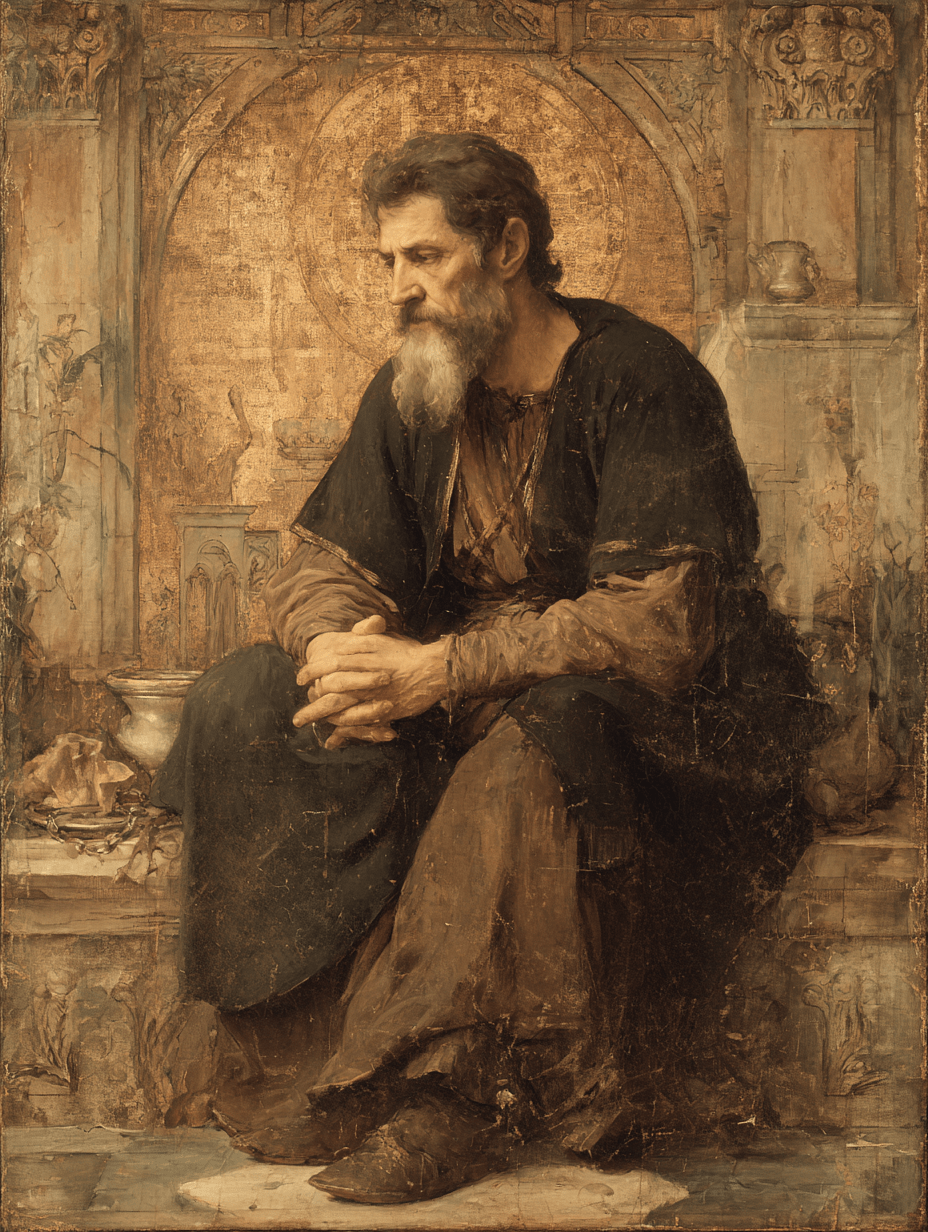
Suffering, Vigilance, and Divine Timing: A Reflection on 2 Timothy 1:1-2, 8-18 and Luke 21:37-22:8 in light of John 1:1-10 for the Fourth Sunday of Advent
Advent requires the courage to remain awake in the darkness just before dawn. The Fourth Sunday of Advent places us at the threshold—the Word is about to become flesh, the light that shines in darkness is about to be born into the world. Yet Paul writes to Timothy from prison, urging him not to be ashamed of testimony or suffering. And Luke shows us Jesus spending his days teaching while his enemies plot, the disciples vigilant but unaware of what approaches. The conjunction reveals something essential: bearing witness to the coming Light requires facing what we’d rather avoid—suffering, betrayal, our own capacity for sleepwalking through sacred moments.
Paul’s exhortation to Timothy carries the weight of someone who knows what’s coming. Do not be ashamed of the testimony about our Lord, nor of me his prisoner, but share in suffering for the gospel by the power of God. This isn’t abstract theology—it’s a man in chains telling his spiritual son: “You will be asked to suffer. Do not run from it.” The Advent context deepens this: before the Word becomes flesh, before the light breaks into the world, there is this moment of decision. Will you bear witness even when it costs you? Will you stay awake even when darkness makes vigilance painful?
The inner work here is recognizing how desperately we want to avoid suffering. Not just physical pain, but the suffering of remaining present to reality when reality is uncomfortable, uncertain, threatening. Paul names the specific temptation: shame. Timothy might be ashamed of Paul (imprisoned, humiliated by Rome) or ashamed of the gospel itself (foolishness to Greeks, scandal to Jews). Shame is what makes us hide, perform, pretend we’re something other than what we are. It’s the voice that says: “Don’t be associated with this. It will cost you too much.”
And beneath shame lies fear. Fear of what others will think. Fear of losing status, security, comfort. Fear of being marked, identified, singled out. These aren’t abstract spiritual failures—they’re the actual feelings that arise when you’re asked to remain faithful to something that makes you vulnerable. Advent invites us to feel this honestly: What are you afraid of losing if you bear witness to the Light? What part of you wants to keep your head down, avoid attention, wait until it’s safe?
Paul doesn’t spiritualize the fear away. He acknowledges it and then points to something stronger: God did not give us a spirit of timidity but a spirit of power and love and self-control. The word translated “self-control” (sophronismos) means something closer to “sound mind” or “discipline”—the capacity to remain present and clear-headed rather than driven by panic or shame. This is vigilance: not the anxious monitoring of threats, but the inner discipline to stay awake to what’s actually happening, to feel the fear without letting fear decide for you.
The Pattern of Suffering Love
Paul then does something crucial: he roots Timothy’s calling in cosmic reality. God saved us and called us to a holy calling, not because of our works but because of his own purpose and grace, which he gave us in Christ Jesus before the ages began, and which now has been manifested through the appearing of our Savior Christ Jesus, who abolished death and brought life and immortality to light through the gospel. This is participatory ontology unfolded in time. Before the ages began—before creation itself—God purposed that death would be destroyed, that life and immortality would be brought to light. The Incarnation isn’t God’s emergency response to human sin; it’s the unveiling of what was always true.
Your calling to bear witness, your suffering for the gospel, participates in this cosmic pattern. When you remain faithful through difficulty, when you refuse to be ashamed even when shame would be easier, you’re not just following moral rules—you’re joining the universe’s movement toward God. Death is being abolished. Life is being brought to light. Your personal transformation (facing fear, choosing love, remaining vigilant) participates in creation’s transfiguration. Hold both: your inner work matters infinitely, and it’s part of something immeasurably larger than your individual journey.
Paul’s testimony becomes almost unbearably personal: All who are in Asia turned away from me, including Phygelus and Hermogenes. He names them. The betrayal isn’t abstract—it has faces, relationships, specific people who abandoned him. And then the contrast: May the Lord grant mercy to the household of Onesiphorus, for he often refreshed me and was not ashamed of my chains. One man wasn’t ashamed. One man remained faithful. The pattern repeats through history: most turn away when the cost becomes real, but some—often quietly, without fanfare—remain present.
This is where Luke’s Gospel intersects with devastating precision. Every day Jesus was teaching in the temple, and at night he went out and lodged on the mount called Olivet. And early in the morning all the people came to him in the temple to hear him. The routine sounds almost mundane: teaching, lodging, returning. But Luke immediately follows with: Now the feast of Unleavened Bread drew near, which is called the Passover. And the chief priests and the scribes were seeking how to put him to death, for they feared the people. While Jesus teaches openly, his enemies plot secretly. While crowds gather to hear him, authorities conspire to kill him. And then: Satan entered into Judas called Iscariot, who was of the number of the twelve.
Betrayal comes from within the inner circle. Not from strangers or obvious enemies, but from one who walked with Jesus, who heard the teaching, who shared meals and ministry. This is the shadow that Advent forces us to face: our own capacity for betrayal, for abandoning what we know to be true when pressure mounts or advantage presents itself. Judas isn’t a cartoon villain—he’s the terrifying reminder that proximity to light doesn’t guarantee fidelity. You can be near the truth and still turn away from it.
Vigilance in Ordinary Time
The Fourth Sunday of Advent asks: Are you awake? Not in some dramatic, apocalyptic sense, but in the ordinary hours when divine presence requires attentiveness. Jesus spends his days teaching while darkness gathers. The people come early to hear him, faithful in their routine, unaware that Passover will unfold differently than they imagine. There’s a peculiar tension here—the sacred is arriving through the ordinary, but the ordinary is charged with imminent revelation.
This is the Advent posture: waiting actively, remaining present to what’s actually happening rather than sleepwalking through the days before the Incarnation. Vigilance means noticing what you’d rather ignore. Paul sitting in prison, naming those who abandoned him. Jesus teaching while enemies plot. Satan entering Judas while the twelve remain oblivious. The darkness before dawn isn’t passive—it’s the moment when your capacity for attention, for staying present, for bearing witness gets tested.
John’s Prologue illuminates what’s at stake: In him was life, and the life was the light of men. The light shines in the darkness, and the darkness has not overcome it. The Word is about to become flesh. The light is about to break into the world. But before that moment, there is this: He was in the world, and the world was made through him, yet the world did not know him. He came to his own, and his own people did not receive him. The tragedy of Advent is that the Light can arrive and still be missed, rejected, betrayed. Not because the Light is insufficient, but because we are not awake.
Paul’s imprisoned testimony, Jesus’s daily teaching, the plotting enemies, the entering of Satan into Judas—all converge on a single question: Will you remain faithful when remaining faithful costs you something? Will you bear witness even when others turn away? Will you stay present even when darkness makes presence painful? Will you recognize the Light when it arrives, or will you be like Judas—so close to the source of life that you share meals with him, yet so asleep that you hand him over for silver?
The Power That Holds in Darkness
Paul offers Timothy (and us) the only anchor strong enough for this vigilance: Guard the good deposit entrusted to you by the Holy Spirit who dwells within us. The “good deposit” isn’t just correct doctrine—it’s the lived reality of God’s presence, the actual communion with divine life that makes transformation possible. You can face the shadow, endure the suffering, resist the betrayal because the Holy Spirit dwells within you. Not as metaphor, not as comfort, but as ontological reality. Your participation in God is real. The Light that will be born at Christmas is already present in you, already transfiguring you from within.
This is why Paul can say share in suffering for the gospel by the power of God—not despite God’s power but through it. Divine power doesn’t exempt you from suffering; it enables you to suffer without being destroyed by it, to remain present without despair, to bear witness without shame. Like Jesus in Gethsemane (which approaches in Luke’s narrative), you can feel the full weight of what’s coming—the terror, the abandonment, the cost—and still choose love. Not by suppressing the fear, but by bringing Christ into the fear and letting grace work within it.
Advent, then, is not sentimental preparation for a baby’s birth. It’s the hard work of staying awake in the threshold time, facing what you’d rather deny, recognizing your capacity for both faithfulness and betrayal. It’s Paul in chains refusing to let shame silence his testimony. It’s Jesus teaching openly while darkness gathers. It’s the daily choice to remain present rather than sleepwalk through sacred moments. It’s the willingness to suffer for the gospel not because suffering is good in itself, but because bearing witness to the Light requires remaining faithful even when faithfulness costs you.
The Word is about to become flesh. The light that shines in darkness is about to be born. But the light is already here, already dwelling within you by the Holy Spirit, already transfiguring you through your willingness to face shadow, endure suffering, resist betrayal. Your vigilance—your refusal to be ashamed, your choice to remain present, your capacity to bear witness—participates in the Incarnation itself. You’re not just waiting for Christmas; you’re joining the universe’s movement as the divine becomes human, as light breaks into darkness, as death is abolished and life brought to immortality.
Guard the good deposit. Stay awake. Bear witness. The dawn is coming, but first—this vigil in the darkness, this choice to remain faithful, this courage to see clearly what approaches and still say yes to the Light.
 The Greater Horizon