

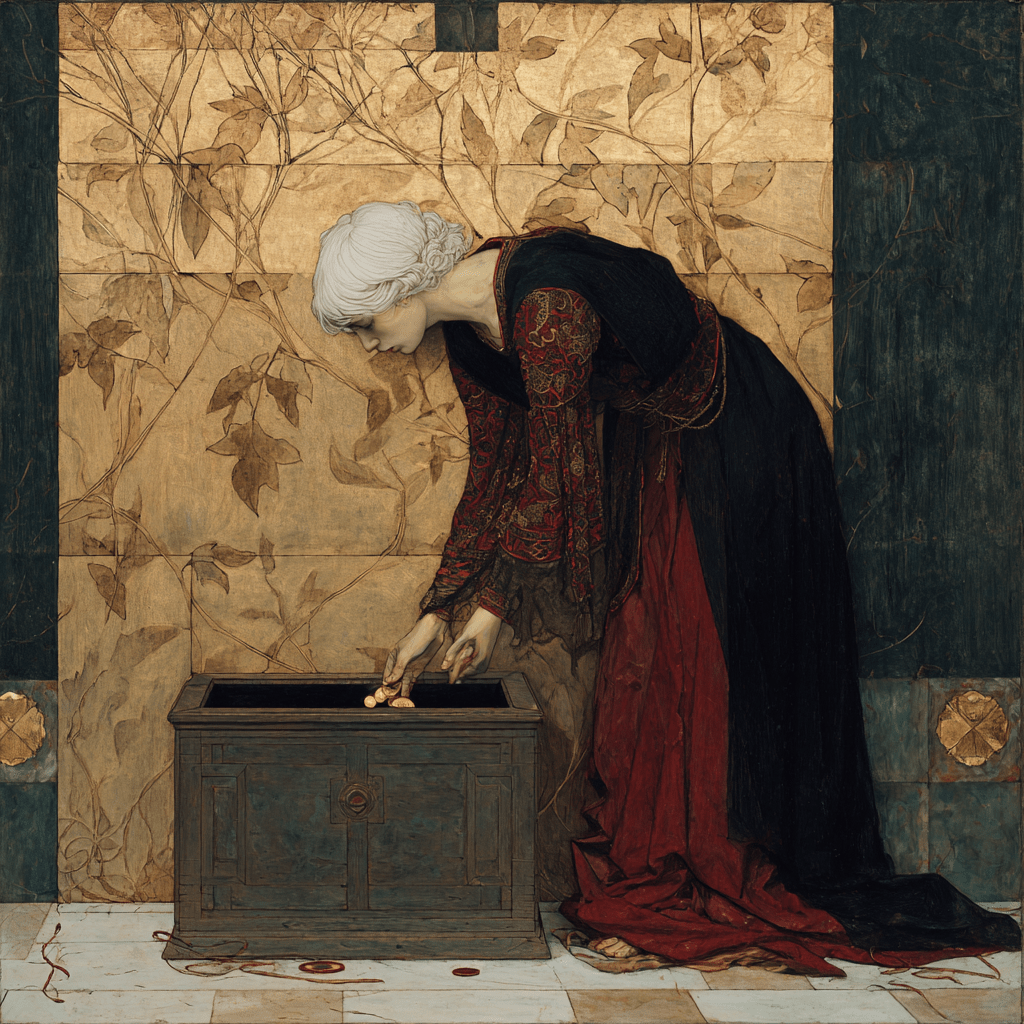
Descent into Glory — A Reflection for Week after Zacchaeus Sunday on 1 Peter 4:12-5:5 and Mark 12:38-44
Zacchaeus climbed down. That is the whole gospel in miniature. The rich man who scrambled up the sycamore to see over the crowd—that grasping, thieving collaborator perched in branches like a child—must descend to meet the One who has already descended to meet him. Make haste, and come down. Not someday, not after you have made yourself worthy, but now, while the crowd mutters and your shame burns. The journey toward Pascha begins always with this coming down, this returning to ground-level where Christ stands waiting in the dust and scandal of your actual life.
The widow at the treasury has already made this descent. She owns nothing but two copper coins—all her living—and she empties even that into the dark mouth of the offering box. The scribes in their long robes sweep past, their purses heavy, their prayers loud enough to impress the gallery. They give from surplus, that cushioned abundance that costs nothing, risks nothing, reveals nothing. She gives what she cannot afford to give. This is not admirable generosity. This is the terrifying mathematics of the kingdom: total gift requires total emptying.
Peter writes to communities learning what this emptying costs. Think it not strange concerning the fiery trial which is to try you. The trial is not punishment but participation—you are entering Christ’s own pattern of descent. He who knew no sin became sin. He who possessed divine glory emptied Himself into slave-form, death-form, hell-form. Kenosis is not the Son’s emergency measure but His eternal nature now extended into your biography. The suffering you face—whether persecution or the slow crucifixion of daily dying to what you thought you needed—is Christ’s passion continuing in your members.
Gregory of Nyssa teaches that “the one who looks upon beauty becomes beautiful.” But beauty’s path leads through deformity first. Christ’s face, Isaiah says, was marred beyond human semblance. The glory Peter promises—when his glory shall be revealed, ye may be glad also with exceeding joy—comes not around the cross but through it. You learn beauty by consenting to be unmade, by standing with the widow at the treasury and discovering you have nothing left to give except the two mites of your broken self.
The scribes resist this descent. They clutch at honor, hoard reputation, devour widows’ houses while performing piety. Their long robes are costume, their prayers theatre. This is not hypocrisy in the modern sense—mere disconnect between public face and private vice. This is the primal distortion: using sacred things to secure the self, turning even religion into armor against transformation. They give much because they possess much and intend to keep possessing. The widow gives all because she has discovered the only possession worth keeping: the freedom of having nothing left to lose.
Peter warns the elders against precisely this scribal instinct: not as being lords over God’s heritage, but being ensamples to the flock. Spiritual authority in Christ’s kingdom operates by downward gravity. The elder is witness to Christ’s sufferings before being administrator of Christ’s benefits. Leadership means going first into the fire, not directing others into it from a safe distance. Be clothed with humility—not as virtue-signaling but as the garment appropriate to creatures who are always receiving, never self-sufficient, perpetually dependent on grace they cannot manufacture or control.
Here the cosmic dimension breaks through: God resisteth the proud, and giveth grace to the humble. This is not moral advice but ontological fact. Pride is the attempt to exist on your own terms, to be self-grounded, to generate your own light. But only God is self-existent. Everything else participates. The proud one, trying to be substance rather than participant, collides with reality itself. Humility is not groveling but accuracy—recognizing that you exist by gift, moment by moment, that the breath in your lungs and the being in your bones are loaned, not owned.
Maximos the Confessor writes: “The one who truly knows himself knows that he is nothing, and the one who knows he is nothing knows God who alone truly is” (Capita de Caritate, 4.35). The widow knows this. Her two mites testify to a heart already emptied of the illusion of self-sufficiency. She casts in her coins not to impress but to complete the outer gesture that matches her inner state. She has descended to the ground-floor of existence where you meet either despair or God, and she has found God faithful.
The Church assigns these readings here, at the threshold of the Triodion, because Pascha cannot be entered climbing. You cannot ascend to resurrection. You can only descend into the tomb with Christ and discover that He has already descended deeper still—into your hell, your poverty, your failure, your two-mite bankruptcy. The fiery trial Peter describes is the burning away of every false foundation, every security not grounded in God alone. Judgment beginning at the house of God means the purging starts with those who claim to know Him, who must now discover whether their knowledge is ornamental or transformative.
The scribes suffer greater damnation not because God is vindictive but because they have immunized themselves against healing. Their robes are too long, their prayers too loud, their self-regard too fortified for grace to find an entrance. The widow, stripped to her last farthing, stands at the treasury utterly exposed—and therefore utterly available. Her poverty is the door through which glory enters.
You stand now between Zacchaeus in his tree and the widow at the treasury, between the rich man called down and the poor woman emptied out. The preparation for Pascha is this education in descent, this apprenticeship to kenosis. What the Father eternally pours out to the Son, what the Son eternally empties into creation, what the Spirit transforms into glory—this pattern now seeks to work in you. Not as violence but as invitation. Not destroying nature but fulfilling it.
The crown of glory that fadeth not away is not reward for enduring humiliation but the revelation of what humiliation has wrought—matter transparent to the divine, the self finally true because finally emptied of falsehood. The widow walks away from the treasury lighter than air, having cast in everything, and therefore possessing everything. This is the mathematics of the kingdom, the alchemy of descent: lose all, find all; die utterly, live eternally; become nothing, participate in the One who is all in all.
 The Greater Horizon