

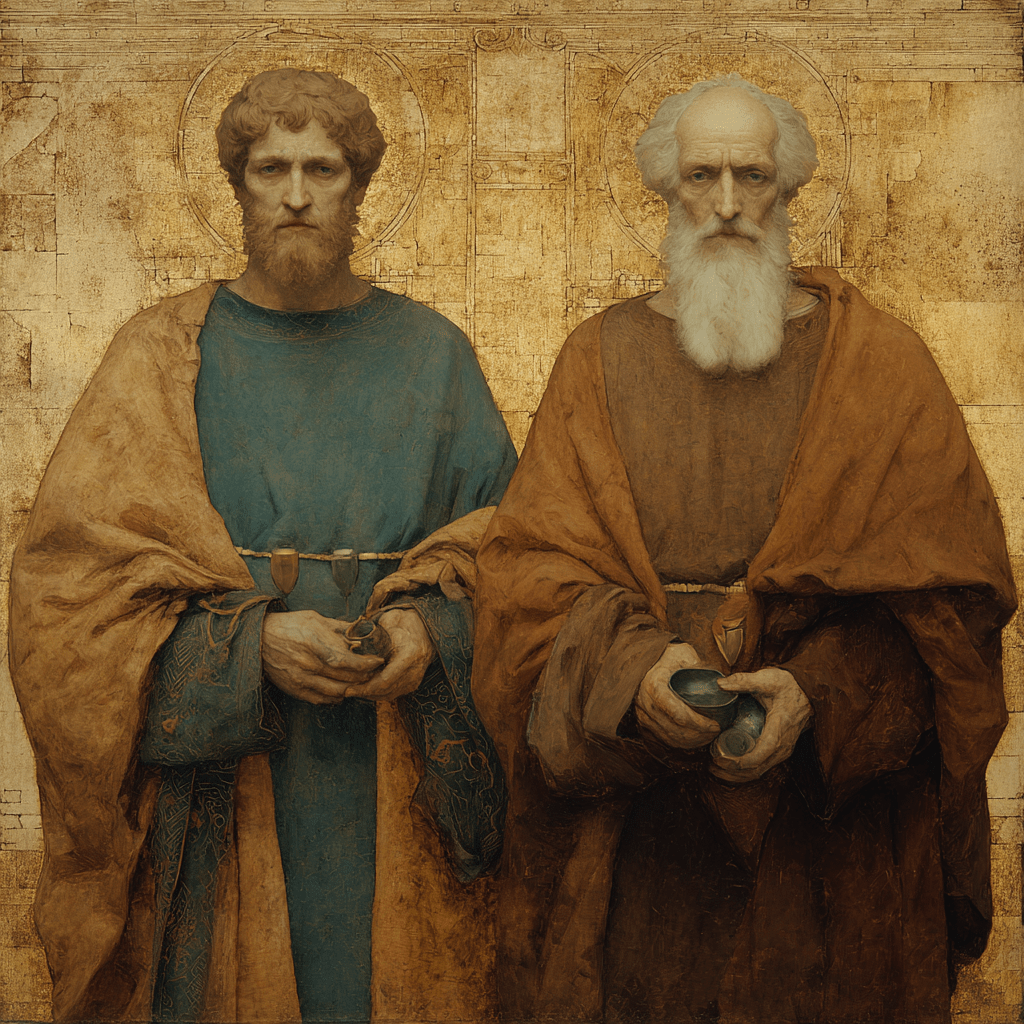
The Life of Saints Cyrus and John (died 311)
Cyrus had everything a man could want in fourth-century Alexandria. A brilliant physician, he moved through marble halls where the sick came seeking his skill with herbs and surgery. He charged nothing—a healer who worked for love, not gold. But something gnawed at him. Rome demanded that Christians offer incense to the emperor’s statue, call a mortal man divine. Cyrus knew the difference between image and reality, between what participates in divinity and what pretends to be God. He would not lie, even to save his life.
So he fled to the Arabian desert. Not running from fear, exactly—choosing a different kind of courage. In the wilderness he lived as the ancient prophets had, close to rock and sky, far from the compromises of the city. He thought he had found safety in solitude.
Then word reached the desert. In the city of Canopus, Roman soldiers had arrested a Christian woman named Athanasia and her three daughters: Theoctiste, Theodotia, and Eudoxia. The youngest was only thirteen. The governor was applying pressure—not just threats, but torture designed to break the will. He knew that mothers crack when they watch their children suffer. Make the daughters scream, and Athanasia would burn the incense. It was a calculated cruelty.
Cyrus heard this and could not stay hidden. A soldier named John—no grand title, just a working man who believed—heard the same news. They did not know each other, but they arrived at the prison at the same hour, drawn by the same unbearable thought: those women should not face this alone.
They found Athanasia and her daughters in cells that stank of fear and iron. The girls were terrified but holding firm. Their mother’s face was stone, but her hands shook. Cyrus and John did what they could—not with medicines now, but with presence. They stood as witnesses. They spoke truth: You are not alone. What you face is real. You are strong enough. No false comfort, no minimizing the horror. Just solidarity.
The governor was baffled by these two men who walked voluntarily into his power. He tried reason, then bribes, then pain. Cyrus the physician, who had spent his life healing bodies, learned what bodies can endure. John the soldier, trained to violence, discovered a different kind of strength—the kind that does not strike back, that remains human even when treated as less than human.
All seven died on the same day. Athanasia and her daughters first, then Cyrus and John. What the governor could not understand was that he had already lost. He could destroy their bodies—and he did, thoroughly—but he could not make them lie. He could not force them to call false things true or dead things divine. Their freedom remained untouched, a thing beyond his jurisdiction.
Later, Christians built a church at Canopus where the martyrs were buried. The sick came, as they once came to Cyrus in Alexandria. Healings were reported—the blind seeing, the lame walking. Cyrus was still a physician, it seemed, working now from the other side of death. The wonderworker who charged nothing had not stopped his work. He had only changed his country.
But the real wonder was simpler: a man who left safety to stand with the terrified. A soldier who chose differently than his training. A mother and daughters who would not be broken. Five people who decided that truth mattered more than survival, that some things are worth dying for because they are the only things worth living for.
 The Greater Horizon