

Relentless Prayer and the Foundation That Holds — A Reflection for Week after Zacchaeus Sunday on 2 Timothy 2:11-19 and Luke 18:2-8
The week after Zacchaeus descended from his sycamore perch, the Church positions you before a widow and a judge—and behind them both, the terrifying question Christ himself poses: When the Son of Man cometh, shall he find faith on the earth? Not doctrine. Not correct theology. Faith—the kind that knocks until knuckles bleed, that refuses the silence of an indifferent cosmos, that will not let God alone until He answers.
Zacchaeus climbed down to face what he had been avoiding. The sycamore gave him distance, perspective, the safety of spectatorship. Christ called him down—into his own house, his own life, his own corruption. Today’s readings continue that descent. You are being prepared for Pascha not by ascending into theoretical holiness but by descending into the actual wreckage of your prayer life, your inconstancy, your exhaustion with a God who seems not to hear.
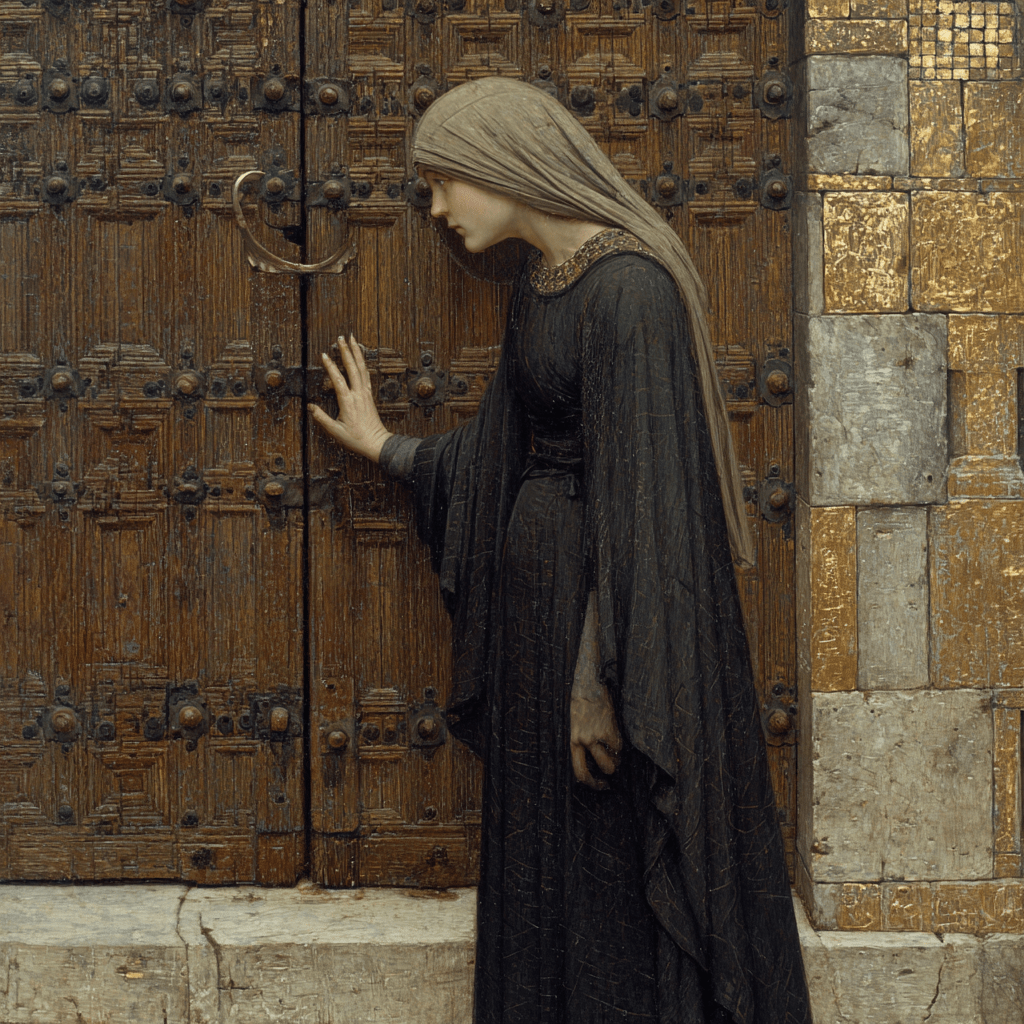
The widow troubles the judge. This is the verb Christ uses—she troubles me. Not “petitions politely.” Not “requests with proper deference.” She troubles. She will not go away. She returns, and returns, and returns until the judge—who fears neither God nor man—relents simply to silence her relentless coming. What kind of prayer is this? Not the mystical rapture of the hesychasts in their caves. Not the liturgical splendor of cathedral worship. This is the prayer of one who has run out of words, out of hope, out of everything except the sheer bloody-minded refusal to stop knocking.
Paul’s epistle names what this widow embodies: If we be dead with him, we shall also live with him; if we suffer, we shall also reign with him. The widow is already dead—socially, economically, legally. A woman without husband in that world possessed no standing, no voice, no avenue of redress. She comes to the judge as one already annihilated by circumstance. And from that place of death, she troubles him. From negation, she generates presence. From silence, she creates noise that will not be ignored.
This is the heart-mystery of Christian prayer. You do not pray from strength but from weakness. Not from fullness but from the hemorrhaging wound that will not clot. Maximos the Confessor writes that “prayer is the ascent of the mind to God”—but this ascent begins by descending into the hell of your actual need. The widow has descended completely. She possesses nothing except her adversary and her demand for justice. And Christ says: Learn from her. Pray like this.
The Church places this teaching here, in the weeks before Great Lent, because she knows what you will face. The forty days ahead will strip away every false consolation, every spiritual narcissism, every pretense that you are praying from abundance. Lent reveals that you are the widow—bereft, harassed by adversaries within and without, knocking on heaven’s door with a desperation that embarrasses your pride. The widow’s prayer is not the prayer you aspire to. It is the prayer you will pray when aspiration fails.
Paul’s words cut deeper: If we deny him, he also will deny us. This sounds like threat until you grasp the ontological structure underneath. Christ is the foundation of God that standeth sure. He cannot deny himself. When you deny Christ, you do not change His nature—you sever yourself from reality’s ground. The denial is not breaking a rule; it is refusing participation in the only Being that is. Paul is not threatening. He is describing what happens when you step off the edge of existence itself.
But immediately Paul adds: If we believe not, yet he abideth faithful: he cannot deny himself. Here is the wideness underneath the widow’s persistence. Even your unbelief cannot unmake the foundation. Even when faith gutters and nearly dies, Christ remains—not because you have held on, but because He cannot deny himself. The widow’s adversary is real. The silence she endures is real. But the foundation holds whether she feels it or not. This is why she can keep knocking. Not because she is strong. Because what she knocks upon cannot be destroyed by her weakness.
Gregory of Nyssa writes: “Hope always draws the soul from the beauty which is seen to what is beyond, always kindles the desire for the hidden through what is constantly perceived.” The widow perceives nothing except the judge’s indifference. Yet she hopes—not in the judge’s mercy but in the sheer necessity of justice itself. She draws her soul toward what she cannot yet see by refusing to accept the visible silence as final word.
This is the spiritual work of these weeks: learning to pray from death. Not mystical death. Actual death—the death of your marriage, your certainty, your capacity to feel God’s presence. The death of whatever you climbed the sycamore to protect. Zacchaeus descended into his corruption and found Christ waiting in that descent. The widow descends into her powerlessness and discovers that powerlessness itself becomes a weapon that even unjust judges cannot withstand.
Paul warns against those who claim the resurrection is past already. Hymenaeus and Philetus spiritualize victory, transforming historical hope into present gnosis. They escape the widow’s trouble by declaring themselves already vindicated. But the widow knows better. Resurrection has not come yet. The adversary still harasses. The judge still delays. And precisely in this not-yet, in this terrible patience, faith is forged.
The great house contains vessels of gold and silver, wood and earth—some to honor, some to dishonor. You are not asked to be gold. You are asked to depart from iniquity, to become a vessel useful to the Master. The widow is earthenware—common, fragile, easily broken. But she is useful. Her very fragility becomes the form of her power. She has nothing to lose because she has already lost everything. This makes her relentless.
Christ asks: When the Son of Man cometh, shall he find faith on the earth? Not “Will there be Christians?” Not “Will the Church survive?” But: Will there be this faith—the widow’s faith that troubles heaven until heaven responds? The faith that prays from death and will not be consoled by anything less than resurrection? The faith that knows the foundation holds even when every surface security has collapsed?
Pascha approaches. You are not ready. The weeks ahead will prove it. You will discover yourself bereft, harassed, knocking on a door that seems locked against you. When that moment comes—and it will come—remember the widow. She is your teacher. Her prayer is not the prayer of the strong but of the dead who refuse to stay dead. And God will avenge His elect speedily. Not because the judge is merciful. Because the foundation cannot deny itself.
orthodoxy, prayer, persistence, theosis, zacchaeus, pascha, lent, widow, faith, resurrection
 The Greater Horizon