

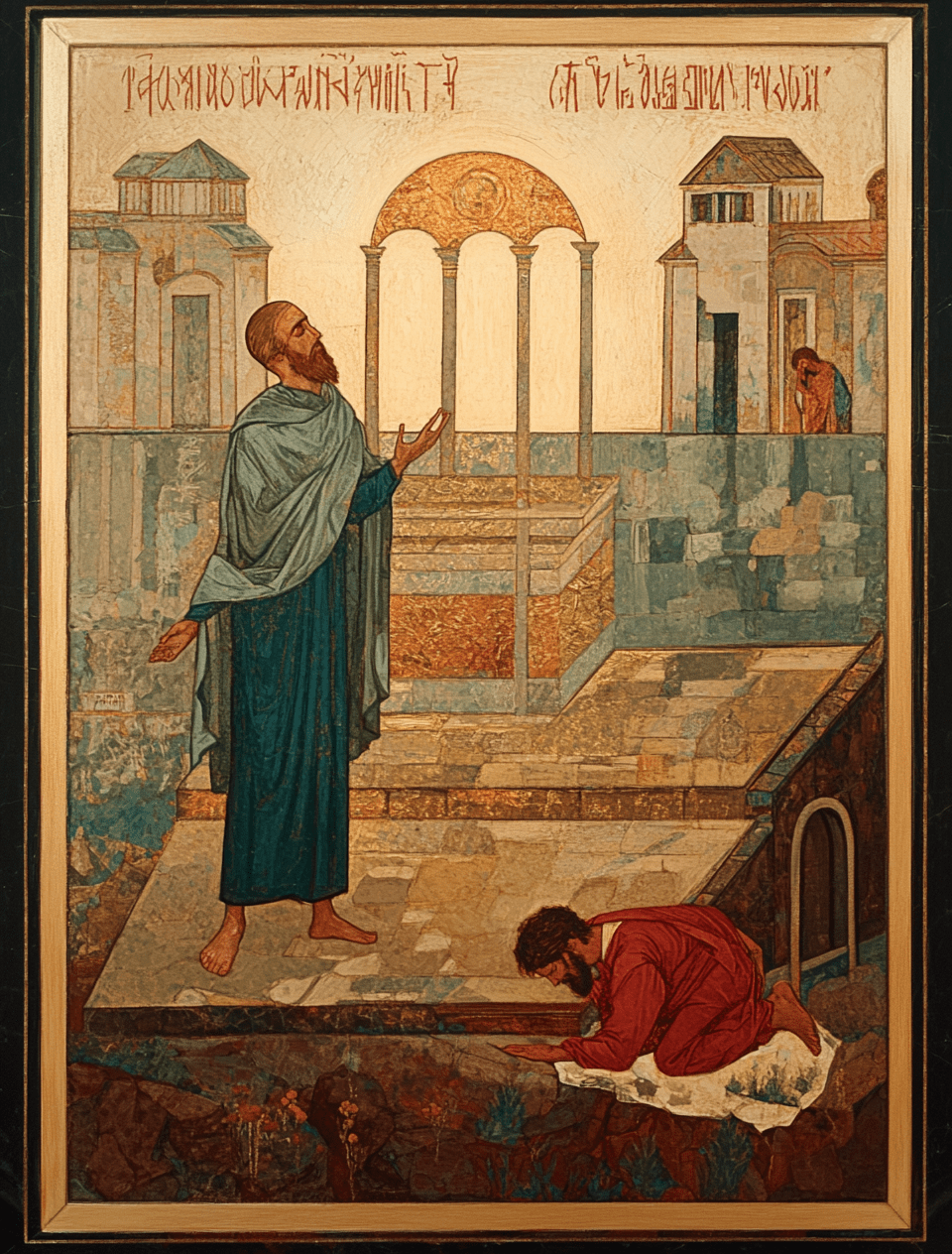
When Power Descends into Weakness — A Reflection for Sunday of the Publican and the Pharisee on Matthew 28:16-20 and 2 Timothy 3:10-15
The eleven go up into Galilee, to the mountain where Christ appointed them. Some worship. Some doubt. Both stand before the same risen Lord, and He speaks to both without distinction. Here is the scandal the Pharisee cannot abide: that doubt and worship can occupy the same heart, the same mountain, the same moment of commissioning. The publican knows this double occupancy intimately. *I believe; help my unbelief.* The paschal journey begins not when you have sorted yourself into certainty but when you bring your unsorted self—doubt, shame, longing, confusion—into the presence that receives all comers.
The Church places these readings here, at the threshold of the Triodion, because **Pascha is not for the sorted but for the混gled**. You stand at the base of Lent with one foot in worship and one in doubt, exactly where Christ meets you. The Pharisee demands you resolve the contradiction before approaching. The publican knows the contradiction *is* the approach. *God, be merciful to me, a sinner*—this is not preliminary work to be completed before spiritual life begins. This is spiritual life, the only kind that endures.
Christ says: *All power is given unto me in heaven and in earth.* Mark the kenotic paradox. Absolute power speaking from a body that died, from flesh that knew abandonment, from a human life that culminated in state execution. This is not power as Rome knew it, not authority as the Temple enforced it. Divine power descends into weakness, works through vulnerability, persuades by beauty rather than compels by force. Gregory of Nyssa saw this clearly: “The Divine Nature, whatever it may be in itself, surpasses every mental concept. For it is altogether inaccessible to reasoning and conjecture, nor has there been found any human faculty capable of perceiving the incomprehensible; for we cannot devise a means of understanding inconceivable things.” Yet this inconceivable power gives itself completely, holds nothing back, empties into created limitation so creation can bear what it could not otherwise contain.
Paul’s testimony to Timothy sounds the same note. *Persecutions, afflictions*—the litany of wounds at Antioch, Iconium, Lystra. *Out of them all the Lord delivered me.* Not from them but through them. Not by suspending consequence but by transforming suffering from within. The paschal pattern again: trampling death by death, redeeming hell by descending into it. When you face what this Lent will ask you to face—the shadow you have been avoiding, the wound you have denied, the rage or grief or terror you have kept locked away—you do not face it alone. Christ has already descended into your private hell before asking you to enter it consciously.
This is the difference between the Pharisee’s asceticism and the publican’s. The Pharisee fasts, tithes, prays—performing righteousness to prove worthiness, white-knuckling his way toward divine approval. Every spiritual discipline becomes strategy for self-justification. He stands before God like a man presenting credentials: *I fast twice in the week, I give tithes of all that I possess.* True facts, sincere effort, utterly barren. Because **transformation from the head can only produce performance; transformation from the heart requires descent into what you have been fleeing**.
The publican will not lift his eyes. He beats his breast. This is not mere emotional display but somatic honesty—bringing the pain into the body where it can be felt, not kept sanitized in the head where it can be managed. Maximos the Confessor understood: “He who has been found worthy of divine knowledge and has, in a divine manner, become by grace what God is by nature and who has learned from God the reasons for God’s creation, has become ‘the temple of God.’” But you cannot become temple while despising the building. You cannot house divine presence while rejecting your own being. The publican’s cry—*be merciful to me, a sinner*—is not self-hatred but profound self-honesty. He brings what he actually is, not what he wishes he were.
Paul tells Timothy: *From a child thou hast known the holy scriptures.* This is formation, not information. Scripture absorbed young sinks into the body’s memory, becomes the heart’s native language before the head learns to dissect and analyze. The paschal journey you begin today draws on everything you already know at levels deeper than conscious thought—the rhythms, the stories, the faces of saints, the smell of incense, the taste of bread and wine. Your body remembers even when your mind doubts.
*Go ye therefore, and teach all nations.* The commission follows immediately upon confession of doubt. Christ does not wait for the disciples’ uncertainty to resolve. He sends them now, in their mixed state, doubt and worship together. This is crucial for understanding what Lent asks. You are not preparing yourself to become worthy of approaching God after forty days of purification. **You are learning to approach exactly as you are—uncertain, wounded, divided—trusting that mercy receives what merit never could**.
*I am with you alway, even unto the end of the world.* The promise grounds everything. Not “I will be with you after you sort yourselves out” but “I am with you”—present tense, continuous action, no conditions. Athanasius proclaimed: “He, indeed, assumed humanity that we might become God.” This exchange—divine taking human nature, human receiving divine life—happens now, in your actual existence with all its mess and beauty together. The mountain where doubt and worship meet is the mountain where heaven and earth join, where the Great Commission sounds forth not despite human weakness but through it.
So you begin. The Triodion opens before you like a doorway into depths. You stand at the threshold with the publican’s posture—not confident in achievement but honest about need. The Church in her wisdom places this reading here because **the paschal transformation you seek begins with facing what the Pharisee will not: that you are loved as you are, not as you should be**. The work ahead—the fasting, the prostrations, the extended services, the intensified prayer—is not currency you exchange for acceptance. It is training in receptivity, making space for the divine life already offered, becoming supple enough to bear the glory that desires to fill you.
Christ speaks from the mountain. Some worship. Some doubt. All are sent. The power given in heaven and earth empties itself into your weakness, works through your uncertainty, transforms by entering rather than avoiding what is broken. You need not resolve the contradiction between doubt and faith. You need only bring both to the One who receives publicans and promises His presence to the end of the age.
 The Greater Horizon