

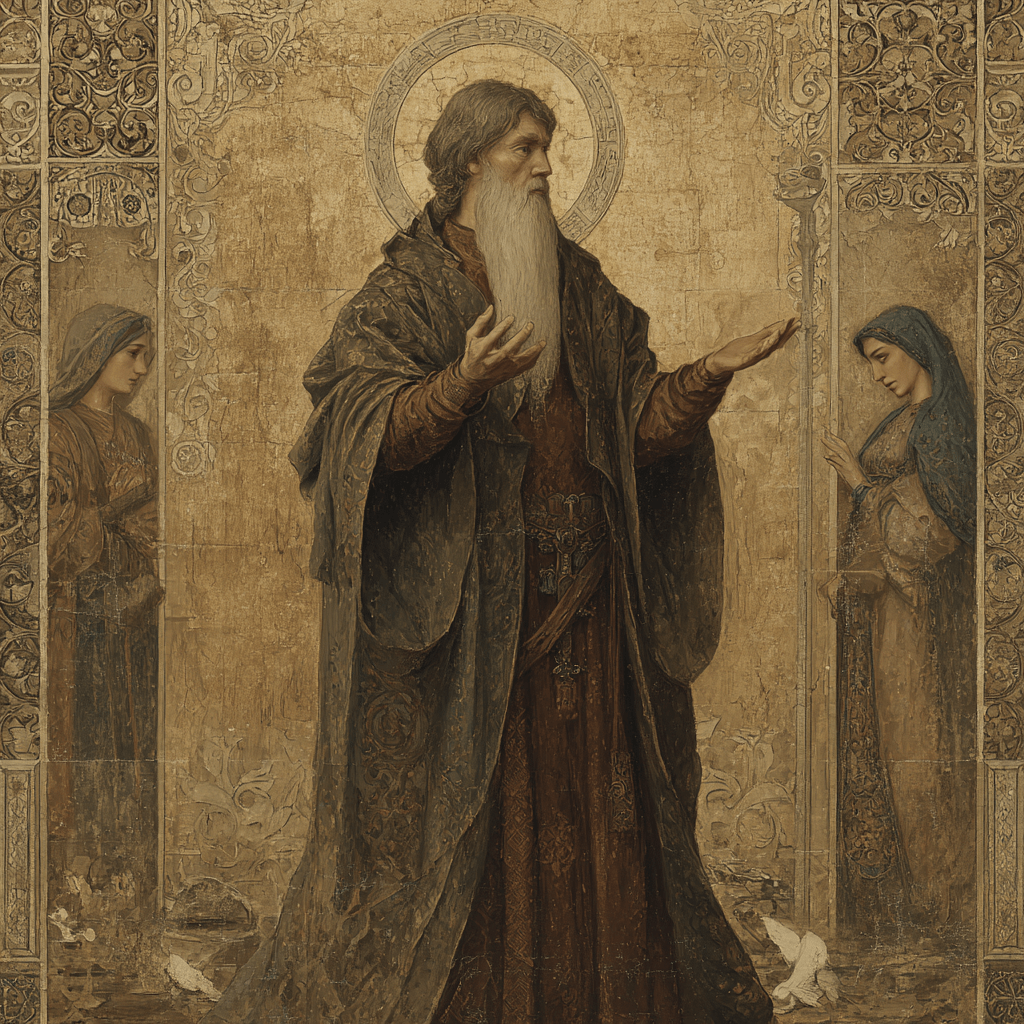
The Life of Saint Simeon the God-Receiver (1st Century)
The old man’s hands shook. They had shaken for years now—the tremor of age, the weight of decades spent waiting for something that everyone else had stopped believing would come. Simeon stood in the Court of Women at the great Temple in Jerusalem, watching young mothers come and go with their firstborn sons, watching priests accept the ritual offerings of turtle-doves, watching the endless rhythm of sacrifice and purification that had ordered his life since boyhood. He was so old that no one remembered exactly how old. Some said he had been a young scholar when the Greek king Ptolemy had summoned seventy Jewish elders to translate the Hebrew scriptures into Greek—and that had been more than two hundred years ago.
The story passed among the priests in whispers. They said that young Simeon had been assigned to translate the scroll of Isaiah, and when he came to the passage about a virgin conceiving a son, he had laughed. Not cruelly—Simeon was never cruel—but with the confident skepticism of a brilliant young man who trusted his own mind above everything else. A virgin bearing a child was impossible. It violated the basic order of nature. Surely the prophet had meant something else, some metaphor his readers had misunderstood. Simeon had lifted his pen to correct the text, to write young woman instead of virgin—and his hand had frozen in the air.
What happened next, Simeon never fully described. He spoke of a presence, a voice that was not quite a voice, a certainty that bypassed his clever mind and lodged directly in his chest. The Holy Spirit—that wild wind that blew through prophets and judges and kings—had settled on him like a bird coming home to roost. And the message was strange and terrible and wonderful: You will not see death until you have seen this very thing with your own eyes.
So Simeon waited. He married, raised children, buried his wife. He watched his children grow old and die. He watched his grandchildren become grandparents. He kept coming to the Temple, day after day, year after year, until his waiting became a kind of legend, then a kind of joke, then simply part of the furniture of the place—the ancient man who haunted the courts, looking for something, though no one could remember what. Some days Simeon himself could barely remember. The fire of that original encounter had faded to embers. Had he imagined it? Had it been the arrogance of youth, wanting to be special, wanting a story that set him apart?
But the Spirit had not released him. That was the strange thing. Even on the days when Simeon’s faith guttered like a candle in the wind, there remained a thread of something—a tug, a pull, a whisper too quiet to hear but too persistent to ignore. He could not stop coming to the Temple. He could not stop watching the mothers and their babies. He could not give up, even when giving up would have been the reasonable thing to do.
On this particular morning, the light fell differently. Simeon noticed it the moment he passed through the gates—a quality to the air, a thickness, as though reality itself had grown more concentrated. His old bones felt strange. His shaking hands grew still. And then he saw them: a young couple, poor by the look of their clothes, carrying the cheapest acceptable offering of two turtledoves. The woman held a bundle against her chest. She looked tired, worried, far too young for the weight she carried. The man beside her had the rough hands of a craftsman and the alert eyes of someone who had recently learned to be afraid.
Simeon moved before he knew he was moving. His legs, which had ached for decades, carried him across the court as though he were young again. The couple startled as he approached—who was this wild-eyed ancient bearing down on them?—but something in his face must have reassured them, because the young mother did not pull away when he reached out his trembling hands.
She placed the child in his arms.
Later, Simeon would try to explain what he felt in that moment, and words would fail him utterly. It was like holding fire that did not burn, like cradling a thunderstorm, like gathering the entire night sky—every star, every spinning galaxy—into the crook of his elbow. The baby weighed almost nothing. The baby weighed more than the world. Simeon looked into that small, scrunched, ordinary infant face and saw looking back at him the same Presence that had frozen his hand over the scroll two centuries before.
Now you may let your servant depart in peace, Simeon said, and his voice rang through the Temple courts, for my eyes have seen your salvation.
The words that poured from him then were not planned, not composed in advance during all those long years of waiting. They came from somewhere deeper than thought. He spoke of light—light for revelation to the Gentiles, light for glory to Israel. He spoke of falling and rising, of a sword that would pierce the young mother’s soul. He saw, in that moment, the whole arc of what this child would become: the teaching that would scandalize the comfortable, the healing that would enrage the powerful, the death that would look like defeat and prove to be victory, the resurrection that would remake the very fabric of existence.
Simeon had waited his whole impossible life to hold God in his arms. And when the moment finally came, it was both smaller and larger than he had imagined—a poor family, a tiny baby, a brief encounter in a crowded Temple court. The salvation of the cosmos arrived without trumpets or armies, wrapped in swaddling clothes, cradled by an old man whose hands had finally stopped shaking.
He gave the child back to his mother. He blessed them, all three, with the blessing that had been building in his heart for two hundred years. And then Simeon walked out of the Temple, out of the story, out of the long waiting that had defined his existence. Scripture tells us nothing more about him—not when he died, not where he was buried. It did not matter. He had held the universe in his arms. Everything after that was epilogue.
What remained was the song he sang, the words the Church still chants every evening at Vespers: Lord, now lettest thou thy servant depart in peace, according to thy word. Every night, all over the world, the faithful echo an old man’s joy at finishing a task he had been given before anyone alive was born.
 The Greater Horizon