

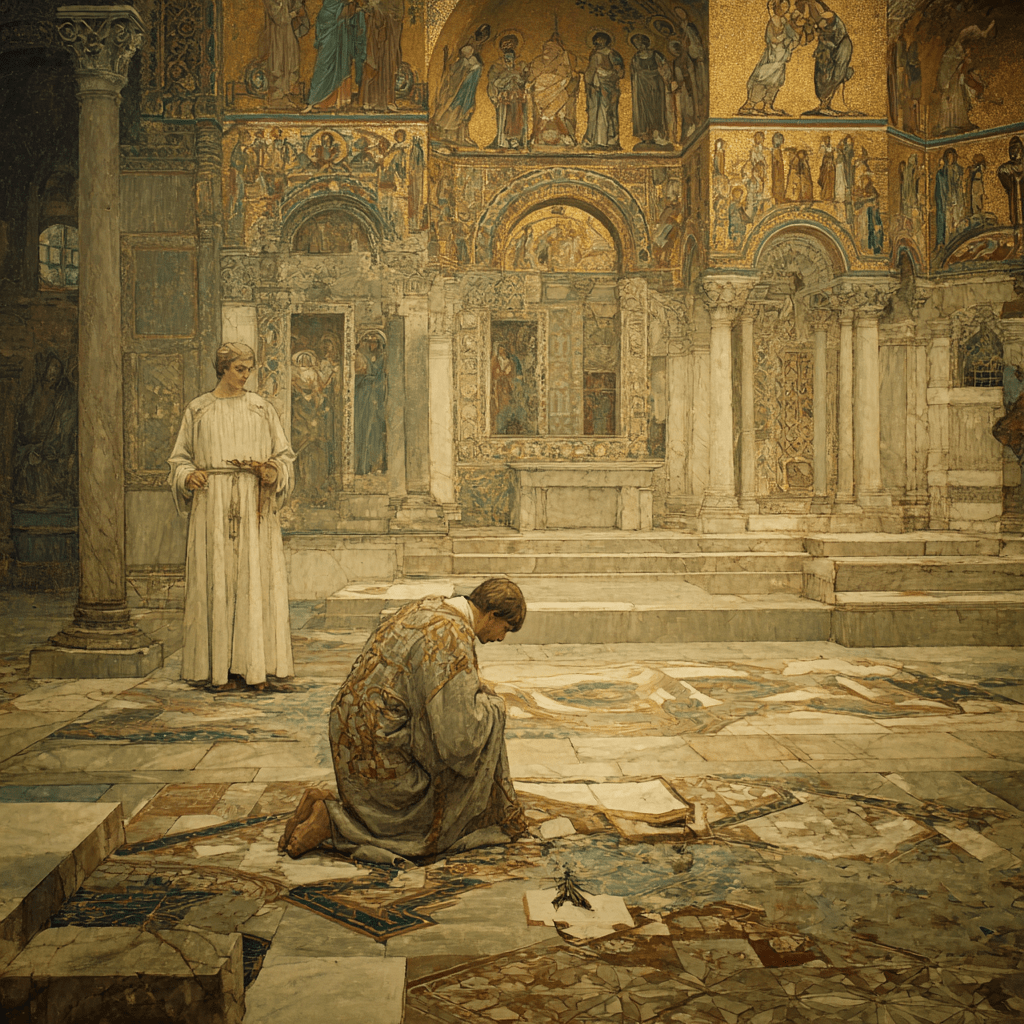
When Hollow Religion Meets the Abomination Within — A Reflection for Week of the Publican and Pharisee (Fast-Free) on 2 Peter 2:9-22 and Mark 13:14-23
The Church suspends the fast this week. Mark that well. Before the long Lenten labor begins, before the body learns again its hunger for God, she bids you eat freely—and in that freedom, face the deeper starvation no bread can touch. The Publican stood afar off, beating his breast: God, be merciful to me, a sinner. The Pharisee stood close, cataloguing his virtues, and went home empty. This is the interpretive key the Church places in your hand as you approach today’s readings. Unlock them with it, and you will find yourself standing where you ought not—in the holy place of your own heart, where abomination and mercy wage their ancient war.
Peter speaks of wells without water, clouds carried with a tempest—images of devastating emptiness, promise without substance, religion drained of its living content. Here is the Pharisee writ cosmic: one who has known the way of righteousness, who can recite it and perform it, yet whose inner spring has run dry. While they promise them liberty, they themselves are the servants of corruption. The false teachers Peter condemns are not outsiders but insiders gone wrong, those who have escaped the pollutions of the world through the knowledge of the Lord only to become entangled again, overcome, returned to their vomit like dogs, to their mire like washed sows. This is not crude invective but precise diagnosis. The sow was washed. The dog did escape. The return to filth is not ignorance but betrayal of what was genuinely known and received.
You recognize this pattern in yourself. You have tasted the waters of mercy. You have known moments when grace cracked your heart open and light flooded the chambers you thought permanently dark. And then—the slow drift back. The performance of virtue replacing its substance. The cataloguing of spiritual accomplishments that makes you stand, like the Pharisee, comparing yourself favorably to publicans and sinners while your well runs dry. Gregory of Nyssa warns that “the one who thinks he stands securely has already begun to fall, for genuine standing in virtue admits no standing still” (On Perfection). The spiritual life knows no stasis. You are always becoming more deeply alive or more thoroughly dead.
But attend to the Gospel, where Christ speaks of the abomination of desolation standing where it ought not. Let him that readeth understand—this parenthetical aside breaks the fourth wall, insisting you recognize that more than historical prophecy unfolds here. The Temple’s destruction looms, yes. But the Temple was always image of something more intimate: your body, your heart, the sanctuary where God desires to dwell. When abomination stands where it ought not, when the holy place becomes occupied by what profanes it, flight becomes the only faithful response. Let them that be in Judaea flee to the mountains.
What occupies your holy place? The Pharisee’s prayer reveals his abomination: a self standing where only God should stand, a heart so crammed with its own righteousness that no room remains for mercy to enter. This is the desolation Peter describes—not the spectacular sins of the flesh, though these follow, but the anterior corruption of presumption and self-will. They are not afraid to speak evil of dignities, whereas angels, which are greater in power and might, bring not railing accusation. The angels know their place in the great order of being. The false teachers, the Pharisees of every age, have lost that holy fear which is the beginning of wisdom.
Isaac the Syrian teaches that “the one who has attained to knowledge of his own weakness has attained to the summit of humility” (Homily 61). This is the Publican’s achievement—not mere self-deprecation, which can be its own twisted pride, but genuine recognition of radical dependency. He does not compare himself to others. He does not even fully articulate his sins. He simply acknowledges the truth of his condition and throws himself on mercy. And mercy, Christ tells us, justified him rather than the other.
The fast is suspended because the work this week is not bodily discipline but something harder: the dismantling of spiritual pretense. You cannot fast your way out of pharisaic religion. Indeed, fasting performed in pharisaic spirit deepens the disease. The Triodion knows this. It gives you a week of feasting precisely to strip away the false comfort that external discipline provides, forcing you to confront the inner emptiness that no rule of life can automatically fill.
Christ warns of false Christs and false prophets showing signs and wonders to seduce even the elect. Peter warns of great swelling words of vanity that allure through fleshly lusts. Both speak to the same danger: the counterfeit that resembles truth closely enough to deceive those who should know better. The Pharisee’s prayer looked like prayer. His fasting was real fasting, his tithing genuine tithing. The corruption was not in what he did but in the self that performed it—a self turned in on itself, using religion as mirror rather than window, finding in God only reflection of its own imagined excellence.
Maximus the Confessor observes that “self-love is the mother of all passions” (Centuries on Love 2.59). This is not the healthy self-love that enables you to love neighbor as yourself, but the curved love that makes self the measure of all things. The Pharisee loved himself wrongly—not with the compassion Christ commands, but with the idolatry that replaces God with ego. The Publican’s breast-beating was not self-hatred but the breaking open of false self-sufficiency, creating space for the only love that heals.
For in those days shall be affliction, such as was not from the beginning of the creation which God created unto this time. The great tribulation is not merely external catastrophe but the inner apocalypse when your false self collapses and you discover you have been a well without water, a cloud without rain. Yet even here, mercy waits. For the elect’s sake, whom he hath chosen, he hath shortened the days. God does not abandon you to endless desolation. The very recognition of your emptiness is grace beginning its work. The Publican went down to his house justified because he consented to know himself unjustified.
This week, eat freely. But let every bite remind you that bread alone will never fill you. The fast is coming—not to earn mercy but to clear space for receiving what is already given. Stand afar off. Beat your breast. Learn to pray the only prayer that opens heaven: God, be merciful to me, a sinner.
publican, pharisee, false teachers, abomination, mercy, self-deception, humility, spiritual pretense, tribulation, Lenten preparation
 The Greater Horizon