

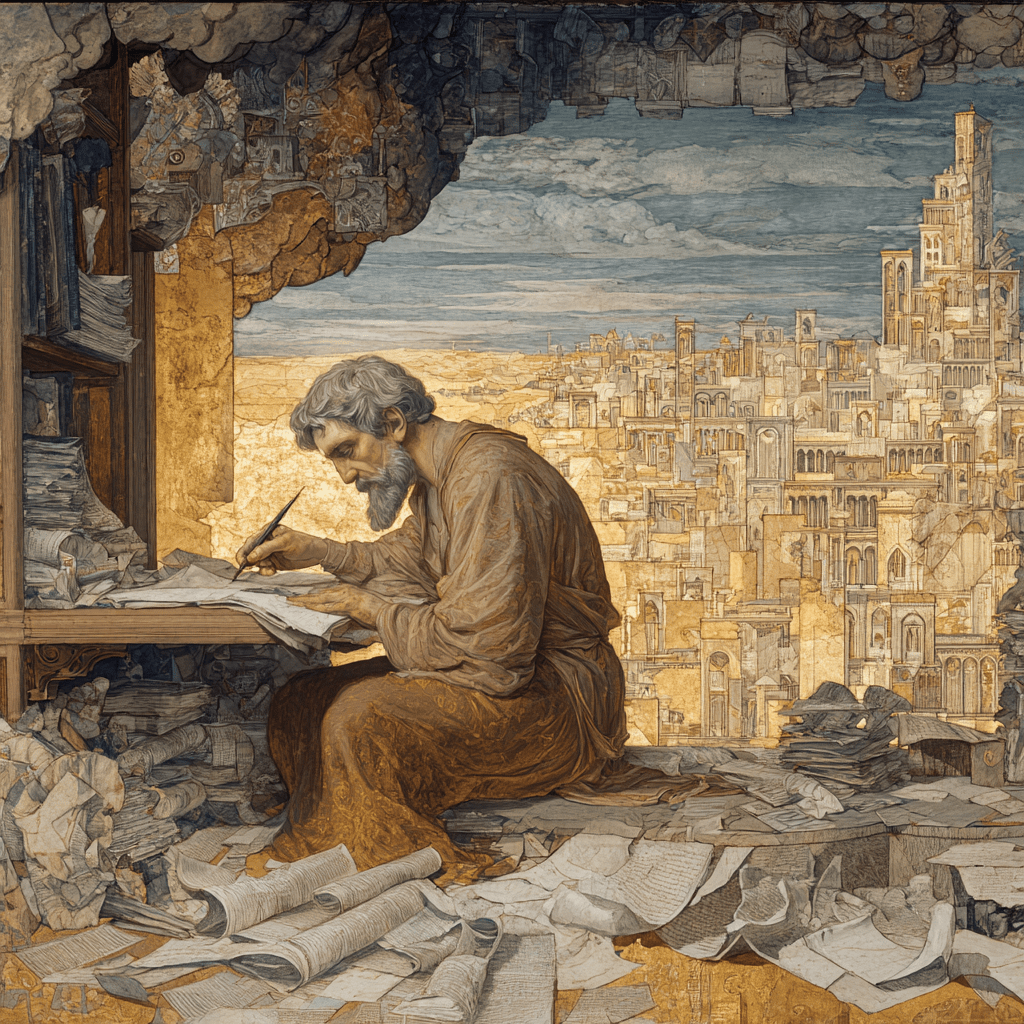
The Life of Saint Isidore of Pelusium (ca. 360-436)
The ship rocked against the Egyptian harbor, and the young man standing at the rail looked back toward Alexandria one last time. Behind him lay everything: the great library, the lecture halls where philosophers debated, the comfortable home of his wealthy family, and somewhere in the city, his famous uncle—Theophilus, the Patriarch himself. Isidore had been groomed for greatness. Everyone assumed he would rise through the church ranks, perhaps become a bishop, perhaps sit in his uncle’s very chair. Instead, he was sailing away to live in a cave.
The decision had not come easily. Isidore loved books the way some people love food or gold. He had devoured everything Alexandria offered: the poems of Homer, the dialogues of Plato, the histories, the sciences, the intricate arguments of theologians. His mind was a palace filled with treasures. But something gnawed at him, a question that would not rest: What was all this knowledge for? He watched the powerful churchmen of Alexandria scheme and grasp and flatter. He saw his own uncle Theophilus destroy good men to protect his position. Was this what learning led to—using wisdom as a weapon for worldly power?
So Isidore chose the mountain instead of the throne. He sailed east to Pelusium, a frontier town where the Nile delta met the desert, where Egypt ended and the wilderness began. There, in the rocky hills outside the city, he found a cave and began a different kind of life.
But here is what makes Isidore unusual among the desert monks: he did not leave his books behind. He brought them with him. While other hermits practiced severe fasting or stood all night in prayer or wore chains against their skin, Isidore’s asceticism took a different form. He wore a rough tunic. He ate simply. But his real discipline was this: he would use his enormous learning only for truth, never for advantage. Every gift of intellect he possessed would serve others, not himself.
Word spread quickly. A brilliant scholar was living in the caves above Pelusium—one who would answer any honest question, help any sincere seeker, and fear no powerful man. Letters began arriving. A young priest confused about a passage in Scripture. A widow unsure how to raise her sons. A governor wrestling with his conscience. A teacher caught in a theological controversy. Isidore answered them all.
Over the next fifty years, Isidore wrote more than ten thousand letters. Some were short—a few sentences of comfort or clarification. Others were long treatises working through the deepest questions of faith and life. He wrote about how to read Scripture (look for the deeper meaning beneath the surface, he taught, the way you look for the soul within a body). He wrote about the classical authors (do not fear pagan wisdom, he insisted; truth is truth wherever you find it, and Plato and Homer can lead you toward the God they never fully knew). He wrote about prayer, about friendship, about raising children, about facing death.
But his most dangerous letters were the ones addressed to the powerful.
When the Emperor Theodosius grew harsh and unjust, Isidore wrote to him—a cave-dwelling monk daring to correct the ruler of the known world. His words were respectful but unflinching: a crown does not make cruelty acceptable; God is watching; repent. When bishops grew proud and worldly, Isidore wrote to them too. He reminded them that their fine robes and grand titles meant nothing if their hearts were empty. Some letters were so bold that friends begged him to soften them. He refused.
Even his own Patriarch received correction. Cyril of Alexandria—Isidore’s own kinsman, nephew to Uncle Theophilus—had inherited the patriarch’s chair and his uncle’s talent for ruthless politics. When Cyril hounded his theological opponents without mercy, Isidore wrote to rebuke him. The old scholar in his cave reminded the most powerful churchman in Egypt that zeal without love becomes persecution, that winning arguments while losing your soul is no victory at all.
What gave Isidore such courage? He had already surrendered everything that could be threatened. He wanted no position, no wealth, no advancement. The powerful could not bribe him because he needed nothing. They could not frighten him because he feared only God. They could not flatter him because he knew exactly who he was: a servant of truth, nothing more and nothing less.
Yet Isidore was no grim moralist. His letters overflow with warmth, with humor, with genuine delight in beauty and learning. He quoted pagan poets with obvious pleasure. He celebrated friendship as one of God’s great gifts. He understood that becoming holy did not mean becoming less human but more so—more alive, more loving, more free.
The monks who gathered around him over the years received something rare: a teacher who combined the scholar’s mind with the hermit’s heart. Isidore showed them that you did not have to choose between wisdom and holiness. The same God who made the human mind also made the human soul, and both were meant to grow together toward their source.
Isidore died in his cave around the year 436, an old man who had spent half a century turning his gift for words into a gift for others. His ten thousand letters scattered across the Mediterranean world like seeds. Centuries later, they would still be copied, still studied, still treasured—the life’s work of a man who proved that real power has nothing to do with thrones or titles, and everything to do with truth spoken from a whole heart.
In the end, Isidore had found what Alexandria could never give him. The knowledge in his head had become wisdom in his heart. The ambitious nephew of a patriarch had become something far greater: a voice in the wilderness that emperors and beggars alike strained to hear.
 The Greater Horizon