

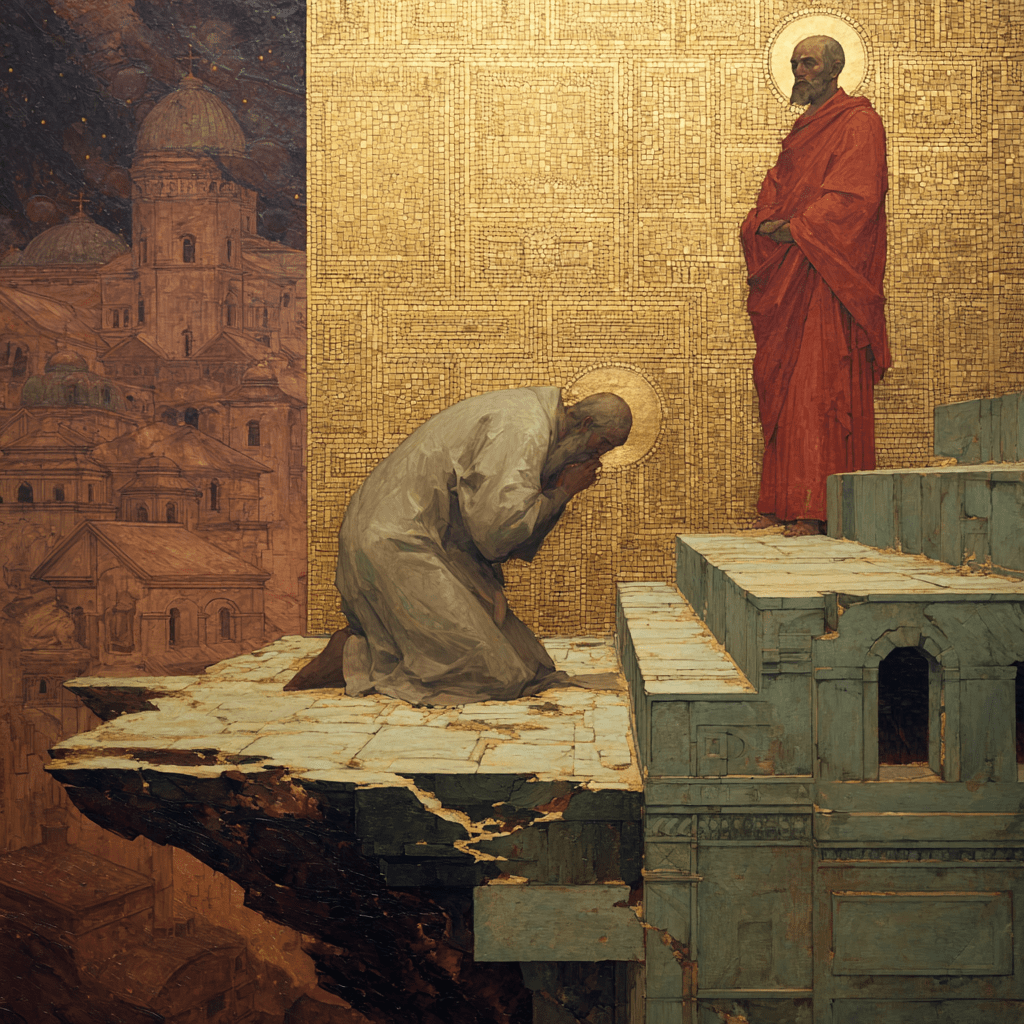
The Cosmos Waits on Your Confession — A Reflection for Week of the Publican and Pharisee (Fast-Free) on 2 Peter 3:1-18 and Mark 13:24-31
The scoffers ask their sneering question—*Where is the promise of his coming?*—and in the asking reveal themselves as Pharisees of the cosmic order. They have counted the days, measured the centuries, tallied the silence, and found God wanting. All things continue as they were from the beginning of the creation, they announce, as though divine patience were divine absence, as though longsuffering were slackness, as though the delay that makes your repentance possible were evidence of a promise broken rather than a mercy extended.
Here stands the Pharisee’s deepest error writ large across the heavens: the presumption that knows better than God how God should act. The Pharisee in the Temple measured his righteousness against the Publican’s sin and found the scales satisfactory. The scoffers measure creation’s continuance against their expectations and pronounce the cosmos in default. Both share the same sickness—**the wound of a heart that cannot receive what it has not earned, cannot wait for what it cannot control, cannot trust what it cannot calculate.**
But you, beloved—Peter’s tender address echoes across millennia—you know something the scoffers have willingly forgotten. The world that then was, overflowed with water, perished. Destruction is not foreign to creation’s grammar. Endings are native to the cosmic tongue. Yet notice: that drowning was not annihilation but purgation, not erasure but renewal. Noah’s flood did not uncreate the world; it washed it. And the fire reserved for the day of judgment—what is this but the same purifying logic written in flame rather than wave? The elements shall melt with fervent heat, yes. But toward what end? *New heavens and a new earth, wherein dwelleth righteousness.*
Maximos the Confessor saw this transformation as creation’s deepest longing: “The whole creation waits with eager longing for the revelation of the children of God, because it was subjected to futility and has been groaning together until now.” [Ambiguum 41](https://www.scribd.com/document/341410814/Maximos-the-Confessor-On-the-Cosmic-Mystery-of-Jesus-Christ) The dissolving is not destruction but delivery. The burning is birth-pang. What passes away is not substance but bondage—the old arrangement that kept heaven distant and earth heavy, the stoicheia that guarded separation rather than facilitated union.
And here the Publican enters the cosmic drama. He stood afar off, Luke tells us, would not lift up so much as his eyes unto heaven. In that posture—broken, honest, unable to measure himself against any standard and come away satisfied—he embodied what the whole creation must learn. *God, be merciful to me, a sinner.* Not: God, I have calculated the odds and found your delay suspicious. Not: God, where is the promise? But simply: mercy. Simply: I am the one who needs it.
The Church, in her wisdom, places this fast-free week at the threshold of Lenten preparation precisely because the fast cannot begin until you have learned to receive. Gregory of Nyssa understood this sequence: “He who would rise to the height of virtue must descend first to the depth of humility.” [On the Beatitudes](https://www.newadvent.org/fathers/2911.htm) The Pharisee fasted twice a week, gave tithes of all he possessed—and went down to his house not justified. The Publican had no resume, no spiritual accomplishments, no measurable righteousness—and went down justified rather than the other.
Do you hear what this means for the cosmic transformation Peter announces? **The new heavens and new earth are not achieved by your striving but received through your confession.** The dissolution of the old order awaits not humanity’s moral improvement but humanity’s honest acknowledgment. The fire comes not to punish but to purify—and you hasten that day, Peter says, by becoming what the day requires: souls capable of receiving what they have not earned.
*But in those days, after that tribulation, the sun shall be darkened, and the moon shall not give her light.* Mark’s apocalyptic vision terrifies only those who have made the sun and moon their gods—those who worship the continuing order, who demand that all things remain as they were, who cannot imagine transformation because they have refused it in themselves. But *when her branch is yet tender, and putteth forth leaves*—here is the turning. The fig tree does not fear spring. The bud does not dread its own blossoming. The tender shoot knows that the shattering of the seed-case is not death but beginning.
John Chrysostom preached that “the Publican, standing afar off, drew near to God; while the Pharisee, standing near, was far from salvation.” [Homily on the Parable of the Pharisee and Publican](https://www.newadvent.org/fathers/240139.htm) The spatial logic inverts: distance becomes intimacy, lowliness becomes elevation, the one who could not lift his eyes found himself seen by the eyes of mercy. This is the pattern the cosmos follows. What seems dissolution is approach. What appears as ending is arrival.
*Heaven and earth shall pass away: but my words shall not pass away.* Here is the word that stands when all else melts—not the word of judgment merely, but the word that spoke creation into being and now speaks recreation into the burning world. The same word that said *let there be* now says *I make all things new.* You are not awaiting destruction but transformation, not fearing fire but leaning into the warmth that makes all things tender, pliable, capable of new form.
This fast-free week asks nothing of your body—no abstinence, no prostrations, no ascetic labor. It asks everything of your heart. Can you stand with the Publican? Can you release your calculations of when and how God should act? Can you receive the longsuffering not as slackness but as salvation—as the patient love that waits for you to become capable of receiving what you have not earned?
The scoffers still ask their question. The Pharisee still measures and compares. But you, beloved—you know that the delay is mercy, the burning is renewal, and the word that shall not pass away is the same word that speaks your justification when you finally stop speaking your own defense.
*God, be merciful to me, a sinner.* Heaven and earth hang on that prayer.
 The Greater Horizon