

On Waste, Love, and the Arithmetic of Grace — A Reflection for the Week of the Publican and Pharisee on 1 John 2:7-17 and Mark 14:3-9
The Pharisee kept accounts. This is what we learn from the parable that governs this week: he stood in the Temple and inventoried his virtues—fasting twice weekly, tithing with precision, maintaining the careful distance between himself and sinners that propriety demands. His prayer was a balance sheet presented to the Almighty, assets neatly catalogued, liabilities assigned to others. The publican, by contrast, possessed nothing to enumerate. He beat his breast and begged mercy. He went home justified.
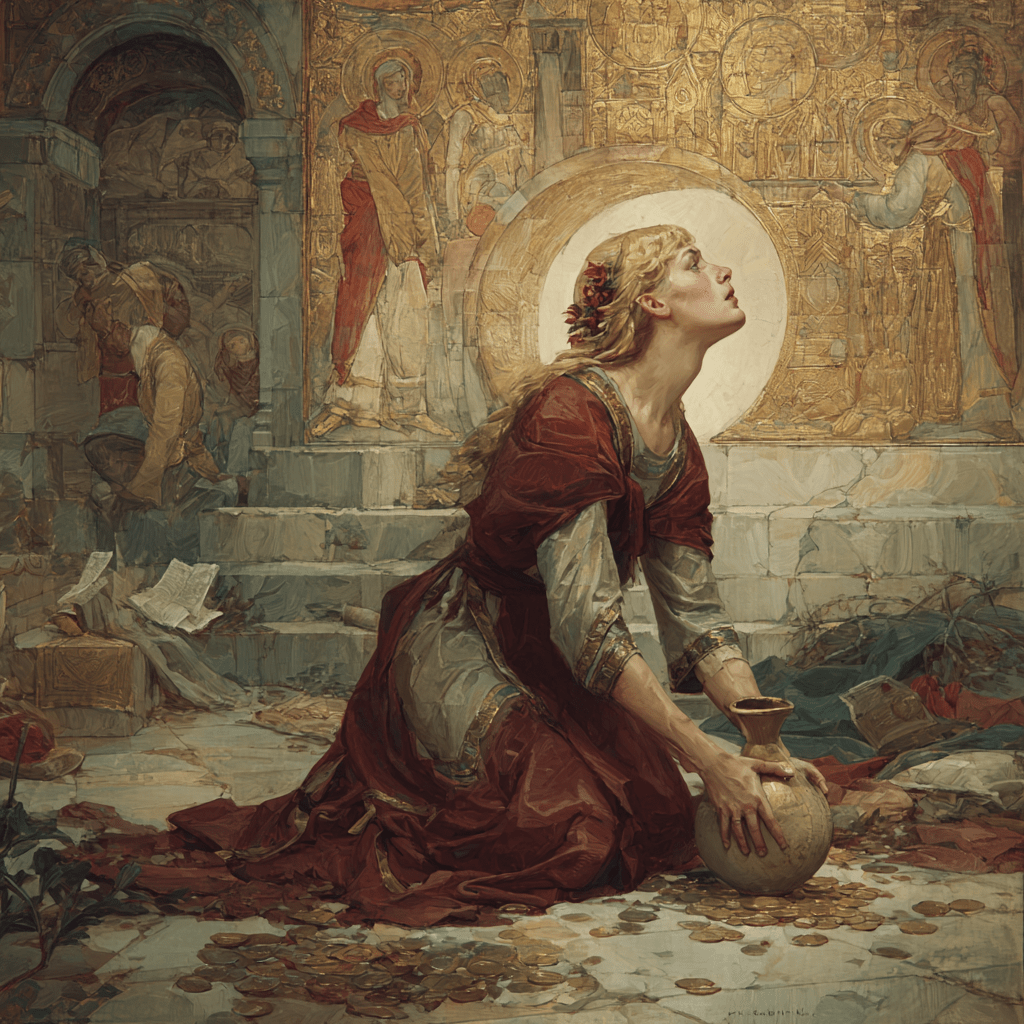
Now the Church, in her liturgical wisdom, places before us a woman who shatters an accounting mentality so thoroughly that we can still hear the sound of breaking alabaster across two millennia. Three hundred denarii—nearly a year’s wages—poured out in a single extravagant gesture upon the head of Christ. The onlookers reached immediately for their ledgers: Why was this waste of the ointment made? It might have been sold and given to the poor. Their objection sounds reasonable. It sounds, in fact, pious. It is the voice of the Pharisee dressed in charitable concern.
But love does not calculate. This is the scandal the Church sets before us as we prepare for the Great Fast. The woman with the alabaster jar understood something the murmurers could not grasp: that certain moments demand everything, that the presence of Christ calls forth a response beyond measure, that extravagance is the native language of genuine devotion. She came beforehand, Jesus says, to anoint his body for burial. She perceived what the disciples could not yet see—that death approached, that time grew short, that the opportunity for this particular act of love would never return.
John’s epistle illuminates the inner geography of this encounter. He that loveth his brother abideth in the light, and there is none occasion of stumbling in him. But he that hateth his brother is in darkness, and walketh in darkness, and knoweth not whither he goeth. The murmurers stumbled precisely because they walked in the darkness of calculation. They could not see where the woman was going—toward that mystery of death and resurrection that the ointment prefigured—because their eyes had adjusted to a dimmer light, the cold illumination of cost-benefit analysis applied to the sacred.
Maximos the Confessor teaches that love is “the willing and joyful death to the self for the sake of the beloved.” The woman at Bethany enacted this death. She broke the jar—not opened it for measured dispensation, but broke it, rendering it useless for any future economy of careful distribution. In that breaking, she broke also with every system that would contain grace within manageable boundaries. The Pharisee’s error was not his fasting or tithing but his belief that such practices constituted a currency with which to purchase divine approval. The woman at Bethany spent everything and kept no receipt.
This week the Church suspends fasting entirely. The gesture appears counterintuitive at the threshold of Lent, yet it carries profound wisdom. We are being taught, before we learn again the discipline of abstinence, that fasting itself can become the Pharisee’s ledger—another line item in the spiritual accounts we present to God. The fast-free week strips away our tools of self-justification so that we might enter the coming struggle from the publican’s posture: empty-handed, beating our breasts, possessing nothing but need.
John warns against loving the world—the lust of the flesh, and the lust of the eyes, and the pride of life—yet the woman’s gift was supremely worldly: fragrant, costly, sensuous, material. Here is the paradox the Church holds before us. The world as system of calculation, as economy of exchange, as arena for the pride that measures itself against others—this passes away. But the world as creation groaning toward transfiguration, as matter awaiting its glorification, as vessel capable of bearing divine presence—this the woman honored with her precious ointment. She touched Christ’s body. She anointed flesh that would hang on a cross and rise from a tomb. Her gift was not escape from materiality but its redemption.
Isaac the Syrian writes that “the person who has found love eats and drinks Christ every day.” The woman at Bethany found love and poured it out with reckless abundance. She ate and drank her Lord before the Supper was instituted, anointing the sacrifice before it was offered. Her memorial endures wherever the gospel is preached because she grasped what we must learn in these preparatory weeks: that genuine encounter with Christ undoes every careful calculation, that the heart’s true fast is from the Pharisee’s arithmetic, that love’s only measure is measurelessness.
The true light now shines, John tells us, and darkness passes away. But darkness lingers in the heart that still keeps accounts—tallying virtues, comparing progress, measuring the distance between itself and lesser sinners. The woman with the alabaster jar stands as icon of what the coming fast must accomplish in us: the breaking of every vessel we have used to contain and control our offering, the pouring out of everything we held in reserve, the fragrance of self-abandonment filling the house where Christ reclines.
Go home justified. Beat your breast. Break the jar. The poor you have always with you—including that poverty within yourself that no spiritual accounting can remedy. But Christ you have now, in this liturgical moment, in this preparation for Pascha. Do what you can. The opportunity will not return in quite this form again.
Pharisee, publican, alabaster, anointing, extravagance, calculation, darkness, light, love, Pascha
 The Greater Horizon