

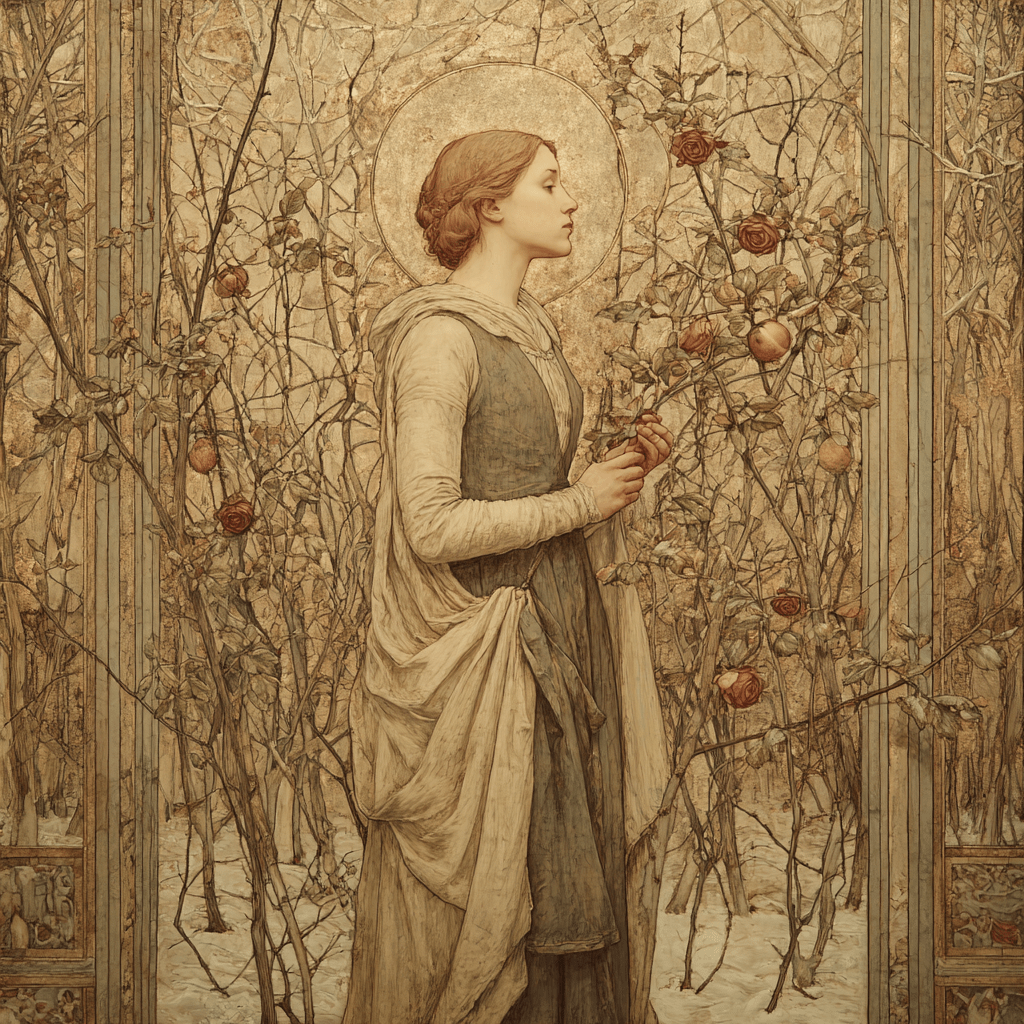
The Life of Virgin Martyr Dorothy of Caesarea (died c. 304)
The executioner’s sword was already raised when the lawyer started laughing. His name was Theophilus, and he stood among the crowd that cold February morning in Caesarea, watching the young woman walk toward her death. She moved like someone going to a wedding feast—not her own execution. This irritated him. He had seen many Christians die, and most of them wept or trembled or at least looked appropriately terrified. But this girl, Dorothy, walked with her head high, and she was smiling.
“Where do you think you’re going, dressed for a party?” Theophilus called out, his voice dripping with mockery. “To meet your bridegroom in Paradise?”
Dorothy stopped and turned toward him. She was perhaps seventeen, with dark hair and eyes that held something he couldn’t name—not madness, not fanaticism, but something like the expression of a person who knows a magnificent secret. “Yes,” she said simply. “That’s exactly where I’m going.”
The crowd snickered. Theophilus pushed forward, enjoying the game. “Well then, when you arrive in this Paradise of yours, send me some flowers and fruit from the garden there. It’s winter here, you know. We could use something fresh.”
The guards laughed. It was a cruel joke—everyone knew that. In a few moments this girl would be dead, her body thrown into a pit, and that would be the end of her and her ridiculous Paradise. But Dorothy only smiled wider. “I will,” she said. Then she turned and walked the final steps to where the executioner waited.
The story of how Dorothy came to that moment had begun years before, in a wealthy household in Caesarea. Her father served in the Roman administration, and her family had converted to Christianity when Dorothy was still a child. She grew up learning two worlds—the Greek philosophy and Roman poetry her tutors taught her, and the strange new faith that met in secret, sharing bread and wine and speaking of a God who had died and risen again.
Dorothy was not a quiet child. She asked questions that made her parents exchange worried glances—questions about why the gods of Rome demanded blood sacrifice while her God gave His own blood instead, questions about why the philosophers taught that the body was a prison while her faith proclaimed that God Himself had taken on flesh and called it good. She devoured books. She argued with her tutors. She had the kind of mind that caught fire easily and burned bright.
When the Great Persecution began under Emperor Diocletian, the comfortable double life of Christian families like Dorothy’s became impossible. Officials went house to house demanding that citizens burn incense to the Roman gods. Those who refused faced imprisonment, torture, death. Many Christians—exhausted, terrified, thinking of their children—performed the sacrifice and tried to forget.
Dorothy refused.
The governor of Caesarea, a man named Sapricius, found her fascinating. Here was a girl from a good family, educated, beautiful, with everything to live for—and she would not bend. He tried flattery first, promising her a wealthy husband if she would only drop a few grains of incense on the altar. Dorothy declined politely but firmly. He offered her positions of honor in the temple of Apollo. She explained, with what seemed like genuine regret for his confusion, that she was already pledged to a greater Lord.
Sapricius grew frustrated. He was used to breaking people. He had Dorothy stretched on the rack, that terrible wooden frame that pulled the body until joints separated and muscles tore. She screamed—of course she screamed; she was human, and the body has its own voice in agony. But when they released the ropes and demanded again that she sacrifice, she whispered, “No.” Her voice was hoarse from crying out, but her will had not broken.
They tried another approach. Two women were brought to Dorothy’s cell—Christina and Callista, who had once been Christians themselves but had renounced their faith under torture. Their job was to convince Dorothy that resistance was foolish, that the Roman gods were real enough to deserve a pinch of incense, that survival mattered more than stubbornness.
What happened in that cell surprised everyone. After hours of conversation, Christina and Callista emerged not as victorious persuaders but as returned believers. Something in Dorothy’s certainty, something in the joy she carried even in chains, had rekindled what they thought they had lost. All three women now faced death together.
This was the Dorothy who walked to execution that winter morning—not a victim stumbling toward oblivion, but a woman who had counted the cost and chosen anyway. She had faced her fears in the darkness of prison cells, wrestled with doubt and pain and the very human desire to live, and emerged somehow more herself than before. The Greeks told stories of heroes who descended to the underworld and returned transformed. Dorothy had made that journey in her own way.
The sword fell. The crowd began to disperse. Theophilus turned to leave, already forgetting his mocking words.
Then a child appeared at his elbow.
No one had seen where the boy came from. He was perhaps six years old, dressed simply, carrying a small basket. “These are for you,” he said, holding it up to the lawyer. “From Dorothy.”
Theophilus looked into the basket and felt the blood drain from his face. There, in the dead of winter, lay three perfect roses in full bloom and three ripe apples, fragrant as summer. They were impossible. They were real. He could smell them, touch them, feel the cool smoothness of the fruit and the velvet softness of the petals.
When he looked up, the child was gone.
Theophilus stood frozen in the winter street, holding flowers from Paradise, while everything he thought he knew about the world rearranged itself around him. The stories say he became a Christian that very day and died a martyr himself not long after, but that is almost beside the point. The point is the roses. The point is that Dorothy, walking toward death, had kept her promise to a man who mocked her—had answered cruelty with extravagant, impossible gift.
She had sent him flowers from the garden.
Dorothy, Theophilus, Caesarea, roses, Paradise, courage, fourth century, martyrdom, winter, transformation
 The Greater Horizon