

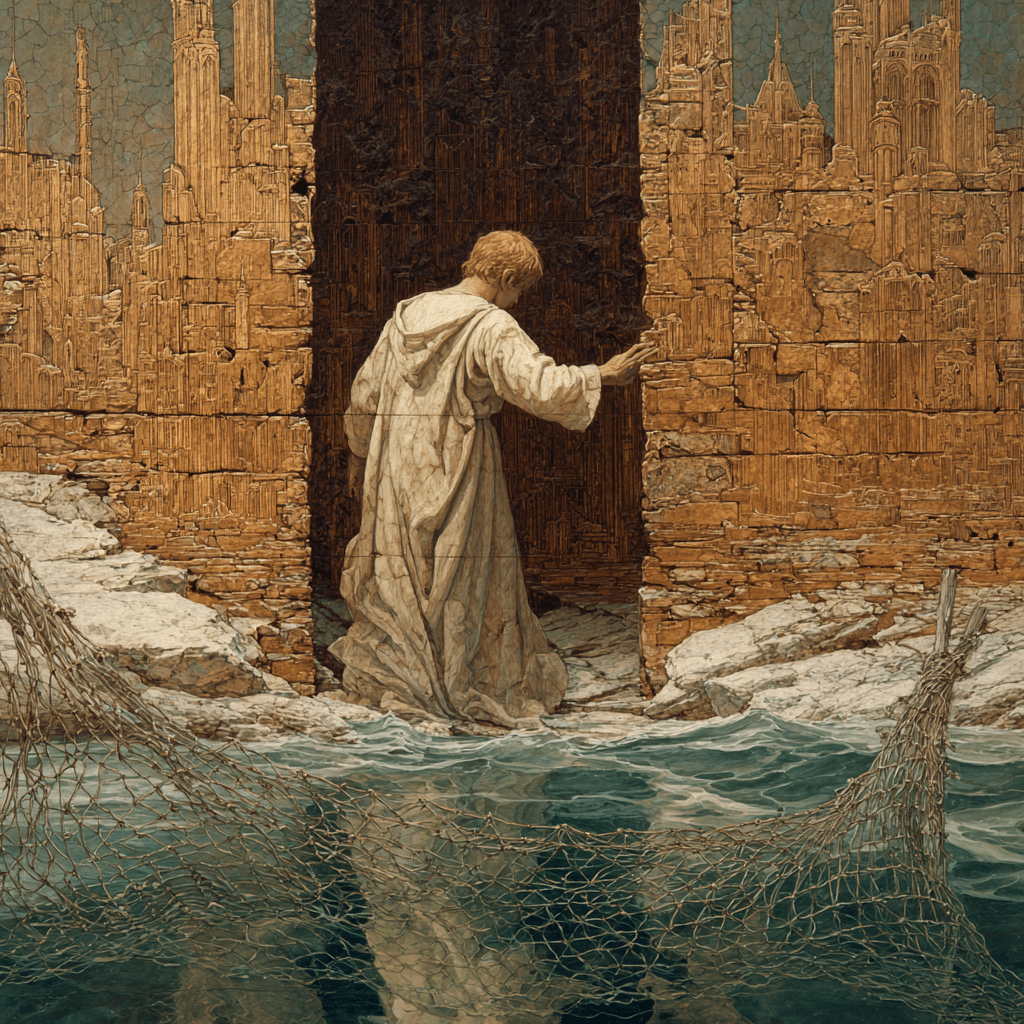
The Life of Saint Parthenios, Bishop of Lampsakos (4th century)
The boy who would become a great healer spent his childhood doing something most people thought was beneath notice: fishing. Not the heroic fishing of old tales, hauling in sea monsters or racing storms, but the quiet, patient work of spreading nets in a lake near the city of Melitopolis. His father was a fisherman, and Parthenios learned the trade the way children learn anything—by doing it alongside someone who loved him.
But here is the strange thing about Parthenios: he never learned to read. The letters that other children scratched into wax tablets remained mysterious marks to him. He could not puzzle out the Scriptures the way scholars did, tracing arguments from Genesis to the Prophets. Instead, he listened. He went to church and let the words of the liturgy sink into him like water into dry ground. He heard the Psalms sung and the Gospels proclaimed, and somehow—through attention, through love, through the mysterious work of grace—the whole of Scripture took root in his heart. He knew it the way a bird knows the air: not by studying flight, but by flying.
The local bishop, a man named Philetos, noticed something unusual about this young fisherman. There was a stillness in him, a depth. When Philetos ordained Parthenios as a priest, it was not because the young man had proven himself clever with theological arguments. It was because Philetos recognized holiness when he saw it—that quality of being fully present, fully alive, fully turned toward God.
And then the healings began.
Word spread through the countryside like fire through summer grass. The priest Parthenios could cure the sick. Not through elaborate rituals or secret knowledge, but through prayer—simple, fierce, unshakeable prayer. People came to him carrying their paralyzed children, leading their blind relatives, supporting friends whose fevers had burned for weeks. Parthenios would pray, and they would rise. He would speak the name of Christ, and sight would return to clouded eyes.
The fame that followed might have ruined another man. But Parthenios seemed almost puzzled by it, as though the healings had nothing to do with him—which, he would have said, they did not. He was merely the channel. The power came from elsewhere.
When he was perhaps fifty years old, the Bishop of Lampsakos died, and the people of that city demanded Parthenios as their new bishop. Lampsakos sat on the Hellespont, that narrow strait where Europe and Asia nearly touch, where ancient Troy had once burned and Greek ships had launched toward glory. It was a city soaked in the old stories, and many of its people still clung to the old gods. Temples to Zeus and Apollo still stood. Incense still rose to Artemis and Aphrodite.
Parthenios did not arrive with soldiers or threats. He came with the same quiet attention he had brought to fishing, to listening to Scripture, to praying over the sick. And he came with power.
The ancient sources describe his confrontations with demons in terms that sound like something from a Greek epic. Invisible forces that had tormented people for years—driving them mad, making them hurt themselves, speaking through their mouths in voices not their own—fled at his approach. He did not shout or perform elaborate exorcisms. He prayed. He commanded. And the darkness broke.
This is where the story becomes strange and wonderful. In the old myths, heroes fought monsters with swords and cunning. Odysseus blinded the Cyclops through trickery. Perseus used a mirrored shield against Medusa. Parthenios used something different: he looked at the darkness directly. He named it. He told it, in the authority of Christ, to leave. And it did.
There is a particular account of a young man possessed by a demon so violent that he had been chained up by his own family—they could think of nothing else to do. When Parthenios arrived, the demon spoke through the young man’s mouth, mocking, threatening, trying to frighten the bishop away. Parthenios did not flee. He did not pretend the darkness was not real. He faced it, prayed through it, and cast it out. The young man returned to himself, whole and free, weeping with relief.
This is what the ancient Christians meant by spiritual warfare: not ignoring evil, not pretending it does not exist, but confronting it with the greater power of love and truth. Parthenios had spent his whole life making himself into someone through whom that power could flow unobstructed. The fishing, the listening, the years of quiet faithfulness—all of it had hollowed him out in the best way, made him transparent to grace.
He also performed a miracle that seems almost playful compared to the exorcisms. A farmer came to him weeping because his crops had been devoured by locusts. Everything was gone—the grain his family would eat, the seed for next year’s planting, their hope for survival. Parthenios prayed, and the locusts—thousands upon thousands of them—flew away. Just like that. The farmer stood in his empty field, watching the swarm disappear over the horizon, hardly able to believe his eyes.
When Parthenios died, peacefully, full of years, the city of Lampsakos mourned him like a father. But the real testament to his life was simpler than any grand funeral: the sick he had healed, the possessed he had freed, the hopeless he had given hope. He had never learned to read, this fisherman’s son from an unremarkable town. But he had learned something more important—how to listen, how to pray, how to stand firm in the presence of darkness until the light won.
The temples to the old gods eventually crumbled in Lampsakos. But the memory of the bishop who faced demons with nothing but prayer and the name of Christ—that endured.
 The Greater Horizon