

The Life of Saint Theodosius the Great, Emperor of Rome (347-395)
The messenger found Theodosius on his family’s estate in Spain, far from the chaos of the imperial court. The young man was thirty-two years old, and he had thought his days of war were behind him. His father, a brilliant general, had been executed by jealous rivals at court—the kind of political murder that made ambitious men learn to keep their heads down and their swords sheathed. Theodosius had retreated to the Spanish countryside, to olive groves and quiet, to a life that asked nothing of him but patience.
The message changed everything. Emperor Valens was dead, killed in battle against the Goths at Adrianople. The eastern half of the Roman Empire lay in ruins, its armies scattered, its borders breached. The surviving emperor, Gratian, was desperate. He needed someone who could fight, someone who could lead, someone who had nothing left to lose. He needed Theodosius.
What made a man say yes to such a summons? Theodosius had watched his father’s reward for loyal service: a headsman’s blade. He knew what empire demanded—everything, and then more, and then your life if you became inconvenient. Yet something in him answered. Perhaps it was the same fire that had driven his father. Perhaps it was the knowledge that the Goths would not stop at the frontier, that the world he knew would burn unless someone stood against the flames. Perhaps it was simply that he could not bear to sit in his garden while Rome fell.
He rode east to meet his destiny.
The empire Theodosius inherited was a fractured thing. The old gods still had their temples and their priests, though Constantine had embraced Christ two generations before. Christians themselves were split into bitter factions—Arians who believed Christ was a created being, and those who held to the Council of Nicaea’s teaching that the Son was of one substance with the Father. Pagans, Arians, Nicenes: they fought in the streets of Alexandria and Constantinople, burned each other’s churches, murdered each other’s bishops. The empire was at war with itself even as barbarians pressed at every border.
Theodosius was a Nicene Christian, and he did not hide it. Within a year of taking the purple, he issued an edict: the faith defined at Nicaea was the true faith of the empire. This was not tolerance—Theodosius believed truth mattered, that ideas had consequences, that you could not build a civilization on foundations of sand. He called a council at Constantinople in 381, and the bishops gathered there affirmed what Nicaea had taught and expanded it, giving the Church the Creed it still confesses today. The Holy Spirit, they declared, proceeds from the Father and is worshipped together with the Father and the Son.
But it was not in council chambers that Theodosius faced his greatest test. It came in a city called Thessalonica, and it came from his own rage.
The people of Thessalonica had rioted. A popular charioteer had been arrested, and the mob demanded his release. When the military commander refused, they killed him—tore him apart in the streets. Theodosius, hearing of the murder of his officer, fell into a fury as cold and terrible as a winter sea. He gave an order. His soldiers obeyed.
Seven thousand people died in the stadium at Thessalonica. Men, women, children—it did not matter. The emperor had commanded, and the army had made a slaughterhouse of the hippodrome.
When the news reached Milan, Bishop Ambrose did something that had never been done before. He wrote to the emperor—not with flattery, not with careful diplomatic suggestions, but with the blunt truth: You have sinned. You have committed murder. You may not receive the Eucharist until you repent.
Theodosius could have had Ambrose killed. He could have found another bishop, a more compliant one, to give him communion. He was the emperor. His word was law from Britain to Mesopotamia. No one could compel him to anything.
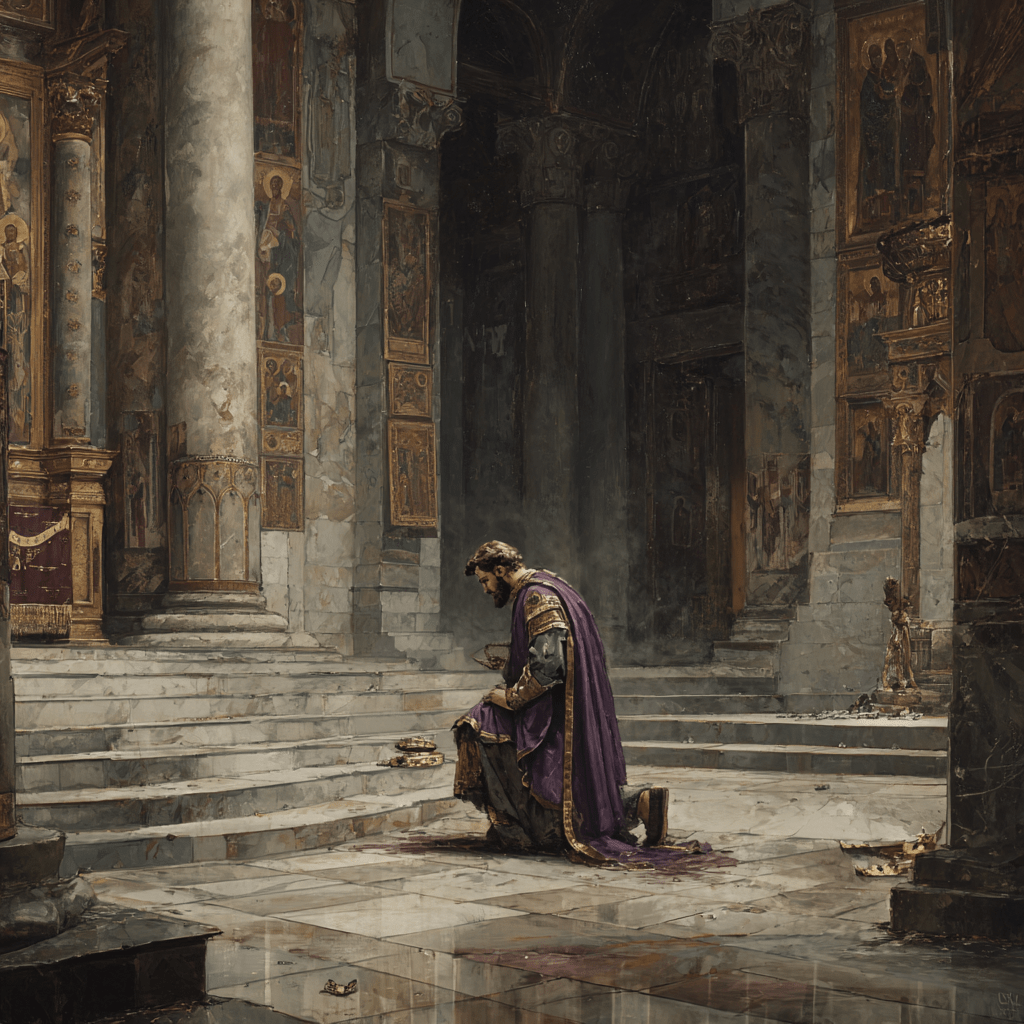
He walked to the cathedral in Milan. He removed his imperial regalia—the purple cloak, the diadem, the symbols of power that set him above other men. He stood in the entrance of the church, not as emperor but as penitent, and he wept. For months he did public penance, confessing his sin before God and the people he ruled.
This was something new in the world. The old emperors had been gods themselves, or claimed to be. They answered to no one. But here was Theodosius, master of legions, ruler of half the earth, submitting himself to judgment. Not because Ambrose had an army. Not because the Church could force him. Because he knew—in that place beneath crowns and titles where a man is simply himself—that he had done evil, and that no amount of power could make evil good.
He returned to communion. He returned to rule. But he was changed.
In his final years, Theodosius worked to end the old pagan sacrifices, not with massacres but with laws. He closed the temples, forbade the ancient rites, turned the empire decisively toward Christ. Historians still argue about whether he was right to do so—whether faith should be spread by law or only by persuasion. But Theodosius believed he was not destroying something living; he was clearing away what had already died, making room for what was being born.
He died in Milan in 395, the last emperor to rule both East and West. The empire would soon split permanently; the western half would fall within a century. But something Theodosius had helped to build would outlast Rome itself: a Church that could speak truth to power, and an understanding that even emperors kneel before God.
The man who had been summoned from his garden to save an empire discovered that the hardest battle was not against the Goths. It was against himself. And that victory—the victory of repentance, of submission, of choosing truth over pride—was the one that mattered most.
Theodosius, repentance, Ambrose, Thessalonica, Constantinople, Nicene Creed, emperor, humility, fourth century, Church and state
 The Greater Horizon