

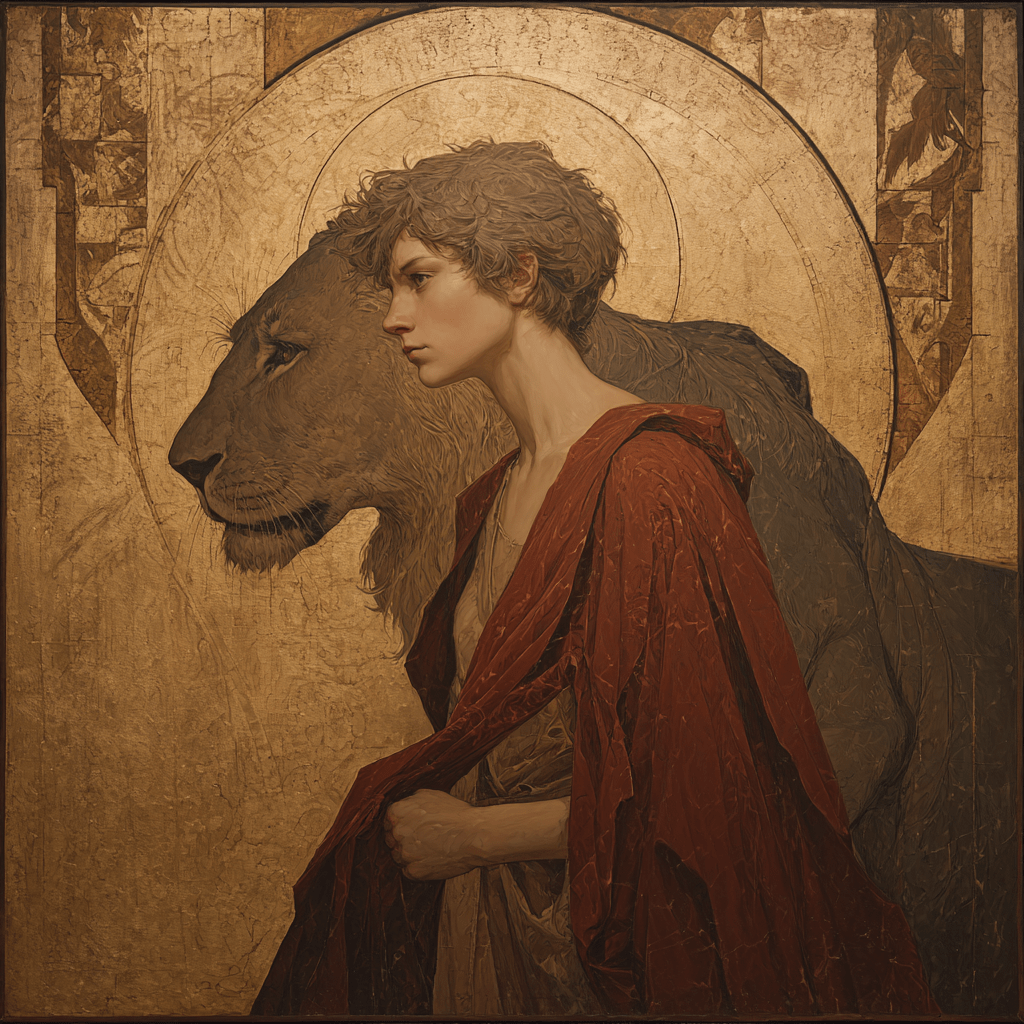
The Life of Saint Thecla, Equal to the Apostles (1st Century)
The lions would not touch her.
Thecla stood in the arena at Antioch, eighteen years old, her tunic torn, her hair loose and wild. The crowd roared for blood. The governor had ordered her death. And yet when they released the beasts—a fierce lioness first, then others—something impossible happened. The lioness walked to Thecla, lay down at her feet, and turned to face the other animals. She fought them off like a mother protecting her cub. When a bear charged, the lioness killed it. When a lion lunged, she met it with claws and fury. The crowd fell silent. They had come to watch a girl die. Instead, they watched her stand untouched while beasts bowed before her, as though the animal kingdom itself had chosen sides.
But this was not where Thecla’s story began.
It began in Iconium, a prosperous city in what is now Turkey, in a house with a window that overlooked the street. Thecla was engaged to be married. Her name meant “glory of God,” and her family expected her to bring them glory through an advantageous match. Thamyris, her betrothed, was wealthy and respected. The wedding preparations were underway. Everything about Thecla’s future had been decided by others.
Then Paul arrived in Iconium.
The apostle was teaching in a house nearby, and his voice carried through Thecla’s window. For three days and three nights, she sat motionless, listening. She did not eat. She barely blinked. Her mother, Theoclia, grew frantic. She shook her daughter, pleaded with her, threatened her. Nothing worked. Thecla had heard something that rearranged everything she thought she knew about herself and the world.
What did Paul say that seized her so completely? He spoke of freedom—not freedom to do whatever one wished, but freedom from the endless hunger for things that could never satisfy. He spoke of bodies as temples, not prisons. He spoke of a kingdom where the last would be first, where slaves and masters sat at the same table, where women prophesied and taught. He spoke of Christ, who had emptied himself of power to show that true strength looked like love.
Thecla recognized something. It was as though she had always known this truth but had never heard it spoken aloud.
When she finally rose from that window, she had made her choice. She would not marry Thamyris. She would follow the Way.
This did not go well.
Thamyris, humiliated and enraged, had Paul arrested and beaten. Thecla bribed her way into Paul’s cell at night, sitting at his feet like Mary of Bethany, learning everything he could teach her. When the guards discovered her there at dawn, the scandal erupted. A respectable girl, alone with a prisoner, abandoning her betrothed—the social order itself seemed threatened.
The governor ordered Paul scourged and expelled from the city. For Thecla, he reserved a harsher sentence: death by burning. Her own mother screamed for the flames to be lit. “Burn the lawless one!” Theoclia cried. “Burn her, so that all women who have learned from this man may be afraid!”
They stripped Thecla and bound her to the stake. The fire was lit. She made the sign of the cross.
Then the sky opened. A sudden storm—rain and hail so violent that many spectators died in the chaos. The flames sputtered and went out. Thecla walked free through the downpour, the fire untouching her as the lions would later refuse to touch her.
She found Paul on the road outside the city. “I will cut my hair short,” she told him. “I will follow you wherever you go.”
Paul hesitated. “The times are hard,” he warned. “You are beautiful. Another trial will come, worse than the fire.”
“Only give me the seal of Christ,” she replied, “and no trial will touch me.”
She was right about the trial. In Antioch, a powerful man named Alexander saw her in the street and tried to seize her. Thecla fought back. She tore his cloak, knocked the crown from his head, and made him a laughingstock before the entire city. For this—for defending her own body, for humiliating a man who thought he could simply take what he wanted—she was condemned to the beasts.
The women of Antioch protested. “An unjust judgment!” they shouted from the stands. “An impious judgment!” A wealthy widow named Tryphaena, whose own daughter had recently died, took Thecla into her home during the days before the execution. She dreamed her dead daughter spoke to her: “Mother, treat this stranger as though she were me, and ask her to pray for me.”
When the day came, Tryphaena accompanied Thecla to the arena. The crowd threw flowers—some in admiration, some in mockery. Thecla saw a pool of water filled with seals—deadly creatures meant to tear her apart. Without hesitation, she threw herself in. “In the name of Jesus Christ,” she declared, “I baptize myself on my last day.” Lightning struck the water. The seals floated to the surface, dead. Thecla rose from the pool unharmed.
Then came the lions. And the lioness who would not harm her.
Eventually, the governor relented. He had seen enough. “Who are you?” he demanded. “What is around you, that not one of the beasts touched you?”
“I am a servant of the living God,” Thecla answered. She did not say it with pride or defiance. She simply told the truth about herself.
She was released. Tryphaena converted and gave her wealth to the poor. Thecla found Paul again and told him everything. “Go,” he said at last, “and teach the word of God.”
She returned to Iconium first, to her mother’s house. Theoclia, who had screamed for her burning, would not see her. Thecla left money for her servants and departed without bitterness. Then she traveled to Seleucia, where she taught and healed for decades, becoming one of the most beloved figures in the early Church. They called her “equal to the apostles”—not a title given lightly, and rarely to women.
She died old, at peace, having chosen her life rather than having it chosen for her. The lions had bowed. The fire had not burned. But the real miracle was simpler: a girl who heard the truth, recognized it, and refused to let anyone take it from her.
 The Greater Horizon