

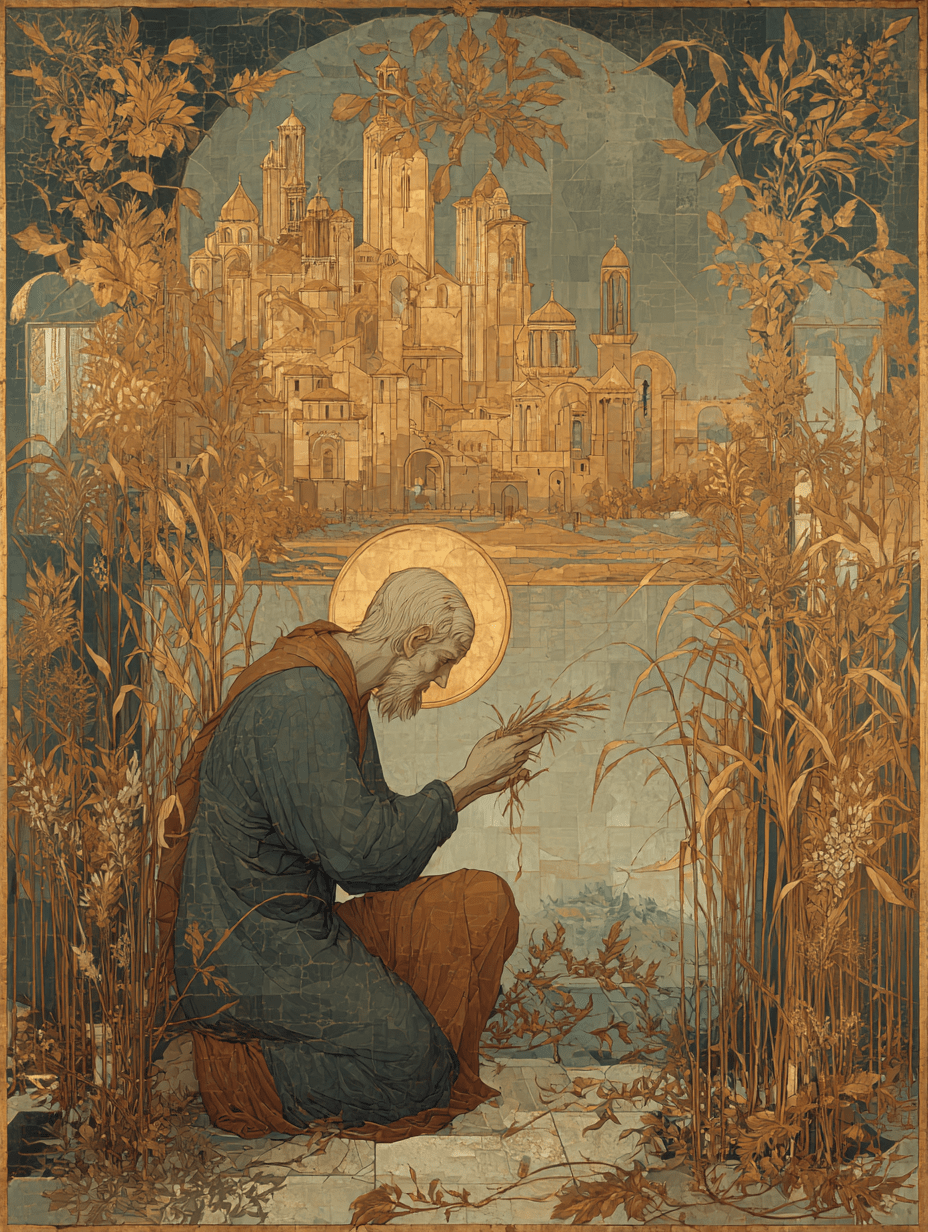
The Life of Venerable Prokhor of the Kiev Caves (died 1107)
The famine came in the third year of drought. The Dnieper River ran low and sluggish past Kiev, and the fields that should have ripened gold lay cracked and barren under a merciless sun. In the great city, mothers measured out their last handfuls of grain. Bakers shuttered their shops. The poor began to die.
But from the caves beneath the Pechersk Monastery, a monk named Prokhor kept emerging each morning with armloads of fresh bread. He distributed loaves to anyone who came—widows, orphans, the sick who could not work. Day after day the bread appeared, soft and warm, though no one had seen him buy flour, and no grain shipments had reached the starving city.
The other monks watched him with wonder and confusion. Where was he getting it?
Prokhor had arrived at the Kiev Caves years before as a young man burning with a strange hunger that food could not satisfy. He came from Smolensk, where his family had enough to eat and a good name. But something pulled at him—a restlessness, a sense that ordinary life, however comfortable, was not the life he was made for. He felt like a character in a story who had wandered into the wrong tale and needed to find his way back to the right one.
At the monastery, the great Abbot Nikon received him and gave him the black robes of a monk. Prokhor threw himself into the life of prayer with fierce joy. He rose before dawn. He stood through services that lasted hours. He memorized psalms until they became the rhythm of his breathing. But it was in the simplest, strangest practice that he found his calling.
Prokhor stopped eating bread.
Not as punishment. Not because he hated his body or thought pleasure was evil. He stopped because he wanted to discover what he actually needed, to strip away everything extra until he found the bedrock of his own existence. What could a person live on? What was essential and what was merely habit?
He began gathering goosefoot—the weedy plant that grew everywhere, that farmers cursed and pulled from their fields. Pigweed, some called it. Food for animals, for the desperate, for no one who had any choice. Prokhor collected it with his own hands, dried it, ground it, and baked it into small loaves for himself alone.
The bread tasted terrible. Bitter and dense, nothing like the wheat loaves the other monks ate. But Prokhor chewed it slowly, grateful, paying attention to each bite as though it were a message he was learning to read. He did this for years, quietly, without announcement or display. The other monks thought him eccentric. Some worried about his health. But Prokhor grew strong and calm, his eyes increasingly bright with some inner clarity.
He was learning something. The body, he discovered, was more resilient and mysterious than people assumed. And the world was more generous than it appeared—full of hidden provisions that most people walked past without seeing.
Then came the famine.
While others panicked, Prokhor felt a strange peace. He knew what to do. He walked out beyond the monastery walls where the goosefoot grew thick and ignored—even in drought, weeds survived—and he began to harvest. He worked from dawn until his hands ached, gathering what no one else wanted. Then he carried his bundles back to the cave where he lived, ground the dried leaves and seeds, mixed them with water, and baked.
When he gave the loaves to the hungry, something impossible happened. The bread that tasted like ashes in his own mouth became sweet on their tongues. Rich and nourishing, like the finest wheat bread they remembered from before the drought. People wept as they ate. They came back the next day, and the next, and Prokhor fed them all.
The city’s professional bakers grew furious. Here they sat with empty shops and idle ovens while a cave-dwelling monk handed out free bread that people said tasted better than anything they had ever sold. They accused him of hoarding secret grain stores, of black market dealings, of making them look like fools and thieves.
A group of them stormed to the monastery and confronted Prokhor, demanding to see his supplies. He led them calmly to his cave. There they found only piles of dried goosefoot, the same worthless weed that grew in every abandoned lot in Kiev. The bakers laughed bitterly and grabbed handfuls to take home. If this mad monk could make bread from weeds, so could they.
But when they baked it, the bread tasted exactly as it should—bitter, ashy, fit only for animals. They spat it out in disgust and threw the rest away.
Prokhor kept baking. The famine kept deepening. And the mystery only grew.
Some who received bread from his hands tried to save pieces for later, tucking loaves away for the next day’s hunger. But when they returned to eat their hidden stores, the bread had transformed again—back to its true nature, bitter weeds and nothing more. The miracle worked only in the giving, only in the moment of gift, only hand to hand.
When the rains finally returned and the crisis passed, Prokhor went back to his quiet life of prayer in the caves. He never claimed any special power. He never explained how the bread worked. He simply continued his strange diet of goosefoot and his long hours of standing before icons in the dark, becoming ever more transparent to something shining through him.
The monks who knew him said that by the end of his life, Prokhor seemed less like a man who had given up the world and more like one who had finally found it—every weed a miracle, every bitter thing potentially sweet, every moment of hunger an invitation to discover what he did not yet know he had.
He died in his cave in 1107, and they buried him in the labyrinth beneath the monastery where his body rests to this day, incorrupt, in the company of a hundred other saints who learned that the way down into darkness is sometimes the way up into light.
Kiev Caves, Prokhor, famine, miracle bread, goosefoot, weeds transformed, hidden provision, kenosis, theosis, generous earth
 The Greater Horizon