

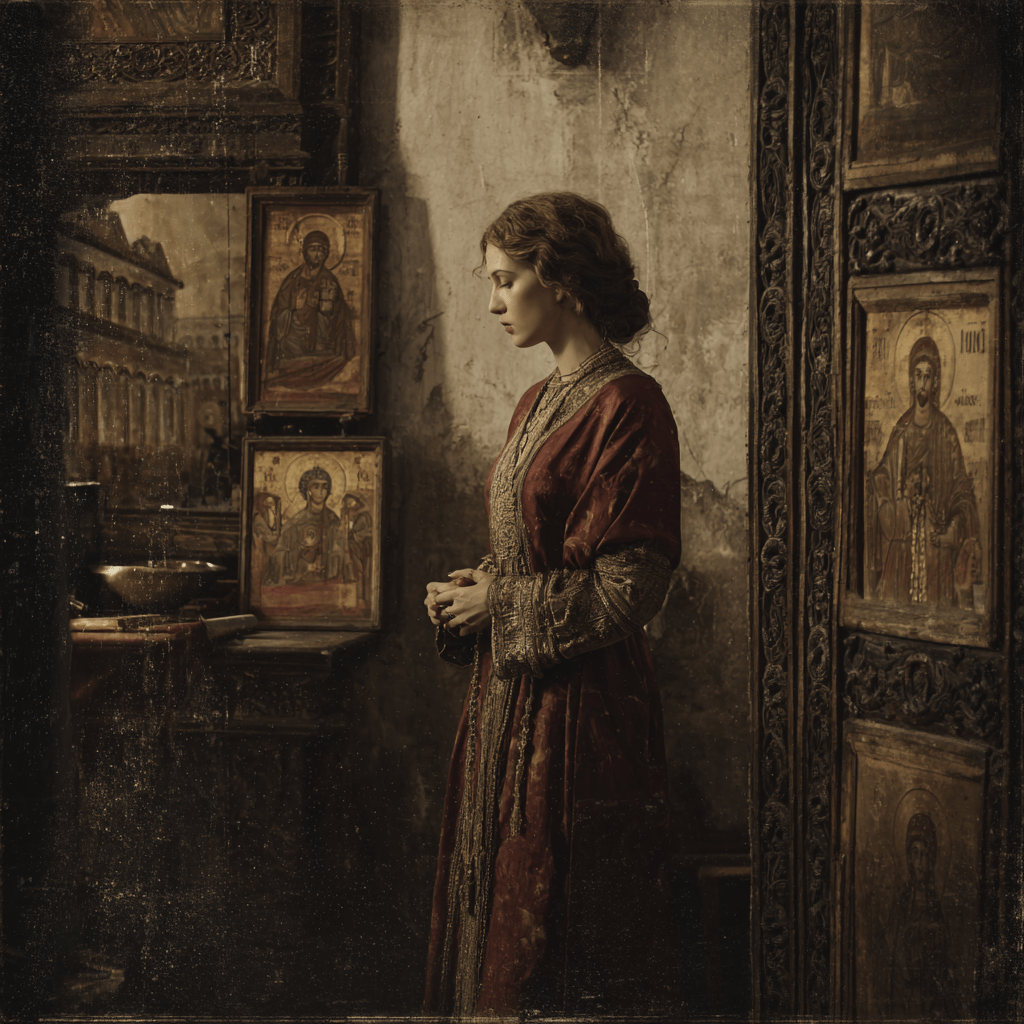
The Life of Saint Theodora the Empress (died ca. 867)
The young woman from Paphlagonia had dark eyes that missed nothing. Theodora had grown up in a household where icons hung in every room—the solemn face of Christ, the tender gaze of His Mother, saints with their hands raised in blessing. She kissed these images as naturally as she kissed her own mother’s cheek, because she understood what the simple village folk understood: the honor given to the image passes to the one it represents. The wood and paint were doorways, not destinations.
When the Emperor Theophilos chose her for his bride from among the most beautiful women in the empire, Theodora entered a palace at war with itself. Theophilos was an iconoclast—a breaker of images. Throughout Constantinople, soldiers scraped the faces of saints from church walls. They whitewashed over mosaics that had gleamed for centuries. They melted down silver icon covers and smashed wooden panels for kindling. The Emperor believed he was purifying the faith, stripping away what he saw as idol worship. He was intelligent, passionate about justice in other matters, genuinely trying to serve God as he understood Him. He was also terribly, tragically wrong.
Theodora found herself in an impossible position—like Penelope weaving and unweaving, working in secret against the current of her own household. She kept her icons hidden. Some say she concealed them in her chambers. Others tell of a faithful servant who guarded them. Her own mother and sisters, living in the palace, helped maintain this dangerous secret. When the Emperor’s own children—Theodora’s daughters—began to venerate the hidden icons, and one of them innocently mentioned “the beautiful dolls” to their father, Theodora had to think quickly. She told Theophilos the child had seen her own reflection in a mirror and was playing a game. The Emperor accepted this, or chose to accept it. Perhaps some part of him did not want to know.
This was not simple deception. Theodora walked a razor’s edge between loyalty to her husband and loyalty to truth. She genuinely loved Theophilos—the histories are clear on this. She did not scheme against him or wish him ill. But she also knew, with the certainty of someone who has encountered the holy through sacred images, that what the iconoclasts were destroying was irreplaceable. Every whitewashed wall was a window being bricked over. Every smashed icon was a connection being severed between heaven and earth.
The iconoclast emperors had their reasons, and those reasons were not entirely foolish. They worried about superstition, about people worshiping the images themselves rather than what they represented. They had seen how the uneducated could confuse the symbol with the reality. But their solution was like burning down a library because some readers misunderstood the books. The Church had already answered these objections a century before, at the Seventh Ecumenical Council, explaining with precision how veneration differs from worship, how matter itself—wood, paint, gold, the stuff of creation—could become a vehicle for divine presence. The iconoclasts refused to listen.
Theophilos died in 842, and everything changed. Theodora became regent for her young son Michael, and suddenly the woman who had hidden icons in her chambers held the power of the Roman Empire. She could have acted immediately, triumphantly, crushing the iconoclast bishops who had supported her husband’s policies. She did not. Theodora moved with patience and wisdom, understanding that forced conversion creates only resentment, not faith.
She called a council. She gathered bishops who had suffered for the icons alongside those who had opposed them. She sought reconciliation rather than revenge. The iconoclast Patriarch was removed, but gently—allowed to retire to a monastery rather than face punishment. A new Patriarch, Methodios, was installed—a man who had been imprisoned and tortured for defending the icons, yet who also understood the need for healing rather than retribution.
On the first Sunday of Great Lent in 843, Theodora led a procession through Constantinople. The icons emerged from hiding. They were carried through streets that had not seen them in over a century. The people wept. They sang hymns. They reached out to touch the images they had kept secretly in their hearts for so long. The churches began to glow again with gold and crimson and the solemn faces of the saints.
The Church still celebrates this day. Every year on the First Sunday of Lent, Orthodox Christians process with icons and sing the triumphant hymns of what is called the Feast of Orthodoxy, the Sunday of the Triumph of Orthodoxy. They are remembering Theodora, the empress who waited, who kept faith in secret, who acted with both courage and restraint when her moment came.
But Theodora’s story has one more twist, one act of love that reveals her character completely. On his deathbed, Theophilos had not repented of iconoclasm. By the strict standards of the time, this meant he had died a heretic, outside the communion of the Church. Theodora, who had spent her marriage secretly opposing his religious policies, now spent her widowhood defending his memory. She insisted—and the council agreed—that Theophilos had repented at the last moment, that he had kissed an icon and been reconciled to the truth. Perhaps he had. Perhaps she needed to believe he had. Perhaps she simply could not bear to see the man she had loved condemned for eternity.
The histories argue about this. What remains certain is that Theodora restored the icons without requiring her husband’s dishonor as the price. She held together what lesser souls would have torn apart—love for an imperfect man and love for the truth he had opposed. She proved that victory does not require vengeance, that courage can coexist with tenderness, that a woman can change the course of an empire while still honoring the complicated bonds of marriage.
She retired to a monastery eventually, as empresses often did. She died in peace, surrounded by the icons she had preserved through years of danger. The Church remembers her as a saint—not because she suffered spectacularly, but because she endured wisely, acted decisively, and loved faithfully even when love was difficult. She had kept the windows open between heaven and earth, and through them, the light still pours.
 The Greater Horizon