

The Life of Venerable Mary (called Marinus) of Alexandria (6th century)
The ship rocked gently in Alexandria’s harbor as a young woman named Mary stood at the railing, watching the great lighthouse fade into morning mist. She was seventeen years old, and she was about to disappear.
Not disappear like a magic trick or a tragedy—disappear like a transformation. Like a caterpillar entering its cocoon, knowing it would emerge as something entirely new.
Her father Eugene stood beside her, his face weathered from years of grief since Mary’s mother had died. For a long time after, he had wandered through life like a man lost in fog. Then something shifted in him. He felt called to become a monk, to live in one of the desert monasteries where men spent their days in prayer and work and silence. But leaving meant leaving Mary alone in the world, and that he could not do.
Mary had watched her father struggle with this impossible choice. Stay and feel his soul slowly starving. Go and abandon his daughter. Neither path seemed bearable.
So Mary had made a third path.
She would come with him. She would become a monk too.
In the sixth century, this was not simply difficult—it was unthinkable. Monasteries were strictly divided. Men lived with men, women with women. A woman could not simply walk into a male monastery and ask for a cell. The monks would turn her away at the gate.
Unless they did not know she was a woman.
Mary cut her hair short. She bound her chest with linen. She lowered her voice and practiced walking differently. She chose a new name: Marinus. And when she and her father arrived at the monastery in the Egyptian desert, the monks saw a quiet young man accompanying his elderly father, both seeking God in the silence of the sand.
The abbot welcomed them. Eugene and Marinus were given cells near each other. They rose before dawn for prayers, worked in the gardens during the heat of the day, and spent their evenings in contemplation. Mary—Marinus now, fully and completely—discovered something unexpected: she was good at this life. Not just surviving it, but flourishing in it.
She had a gift for prayer that went deep, like water finding underground rivers. She worked harder than most of the younger monks, never complaining about the labor or the sparse food. The other monks began to notice this quiet young man who seemed to carry a kind of peace with him wherever he went.
Years passed. Eugene grew old and eventually died, surrounded by his brothers in prayer, with Mary holding his hand. She was alone now, truly alone—the only person who had known her secret was gone. She could have left. She could have returned to Alexandria, resumed her old name, lived openly as a woman.
She stayed.
The monastery had become her home. The monks had become her family. And the person she was becoming—this patient, prayerful, hardworking soul called Marinus—felt more real to her than the frightened girl who had boarded that ship years ago. She was not pretending to be someone else. She was becoming herself, just in an unexpected form.
Then came the accusation.
A young woman from a nearby village claimed that Marinus had fathered her child. The accusation was absurd—Mary knew her own body, knew exactly why it was impossible—but she also knew that defending herself meant revealing everything. It meant exposing her secret, likely being expelled in disgrace, watching the life she had built crumble into sand.
The abbot summoned Marinus. The other monks stared. Some looked angry. Some looked betrayed. The abbot demanded an explanation.
Mary said nothing.
Not because she was afraid. Not because she was weak. But because she had thought about it carefully and chosen silence. If she revealed herself, the monks who had lived beside her for years would feel deceived and ashamed. The monastery’s reputation would suffer. And the young woman who had lied—probably to protect the actual father of her child—would face harsh consequences.
So Marinus accepted the punishment. Expelled from the monastery. Forced to live outside the gates like a beggar. Required to raise the child—who was brought to her as soon as it was born—as penance for a sin she had never committed.
Mary raised that boy with more love than many children born to their natural parents ever receive. She taught him to read. She told him stories. She showed him how to pray. She never spoke a bitter word about the injustice done to her. The child grew strong and kind, shaped by the fierce, quiet love of this strange monk who had been given charge of him.
Years later, when Marinus was dying, she called the abbot to her cell. The other monks gathered outside, curious about this disgraced brother’s final moments. And Mary finally told the truth.
When the monks prepared her body for burial and saw the evidence of what she had hidden for so long, the abbot wept. He fell to his knees before her simple bed and begged her forgiveness—not for what he had done to her, but for what he had failed to see. All those years, a saint had lived among them, and they had thrown her out like garbage.
The young woman who had lied was brought to Mary’s cell. Standing before the body of the woman she had wronged, she confessed everything. Something broke open in her that day—the weight of her lie had been crushing her for years without her knowing it.
Mary was buried with full honors, celebrated as one of the monastery’s holiest members. The child she had raised grew up to become a monk himself, shaped by her example into someone gentle and true.
Like Athena taking the form of Mentor to guide young Telemachus, Mary had hidden her true nature in order to accomplish something that seemed impossible. Like the heroes of old stories who descend into darkness and emerge transformed, she had entered a kind of death—the death of her old identity—and found resurrection in becoming someone both new and deeply herself.
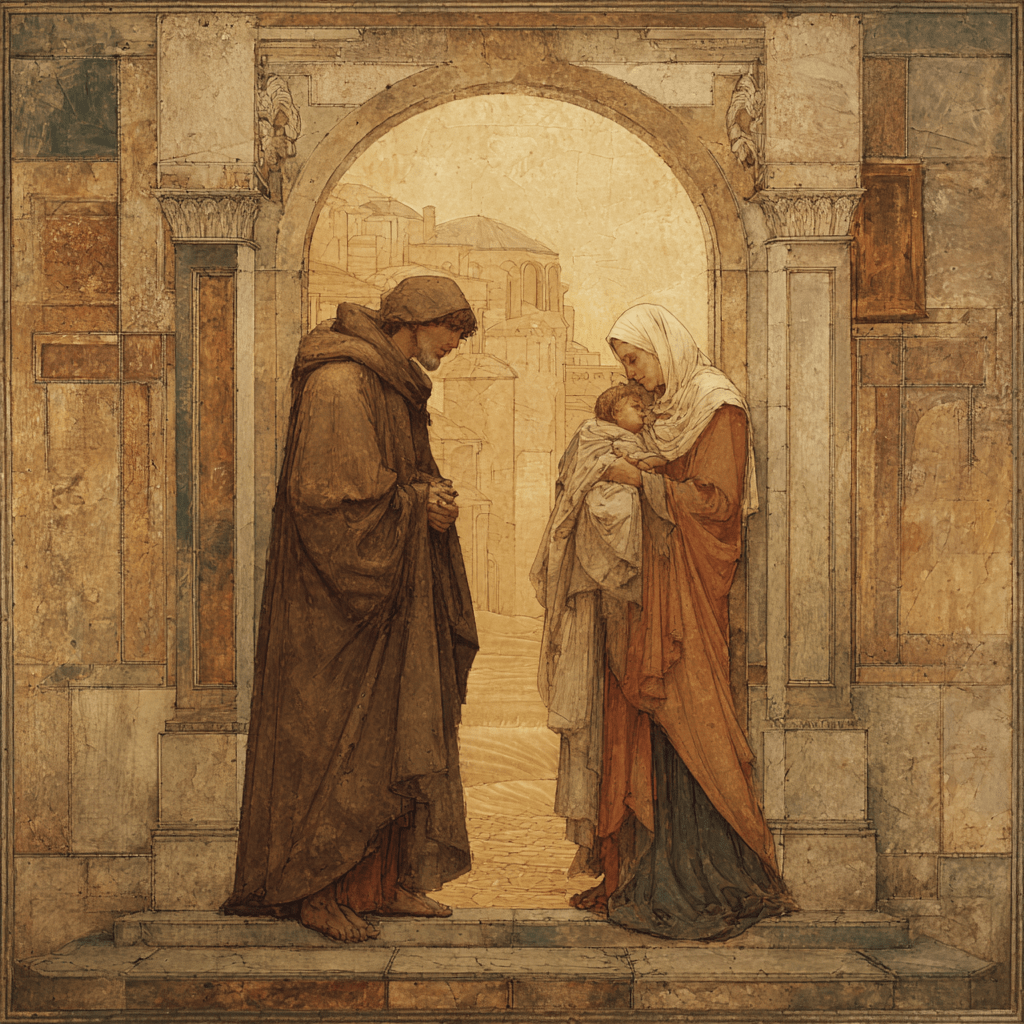
The icon painters show her in monk’s robes, her face serene, often holding the child who was never hers but whom she loved completely. They do not show the moment of accusation or the years of exile. They show what endured: a woman who chose silence over self-defense, love over vindication, and who discovered that the truest form of strength sometimes looks like surrender.
 The Greater Horizon