

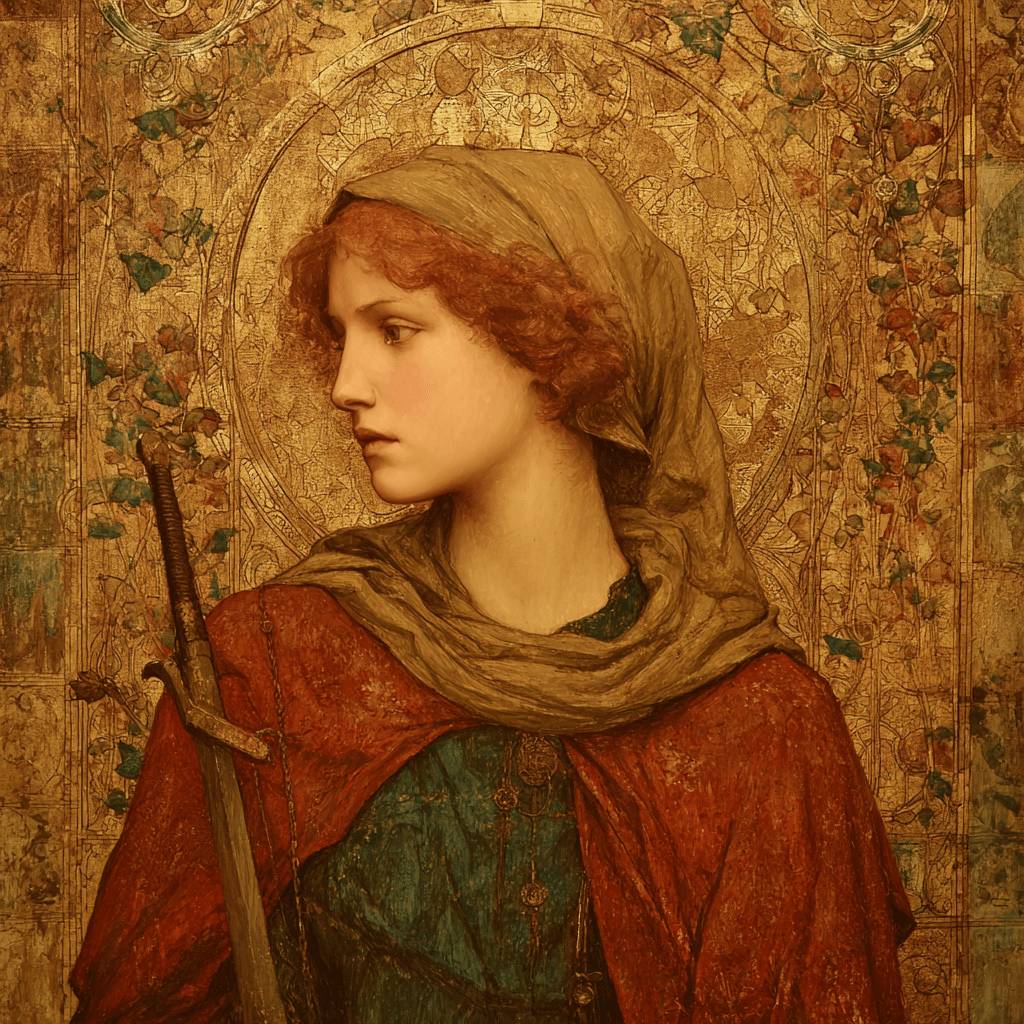
The Life of Saint Brigid of Kildare (c. 451–525)
The baby was born at sunrise on the threshold of a doorway—half inside the house, half outside it—and the women attending the birth said afterward that this was fitting, because Brigid would spend her whole life standing on borders between worlds. Her mother was a slave. Her father was a chieftain. In the green, rain-soaked hills of fifth-century Ireland, that made Brigid something the social order had no comfortable place for: a girl who belonged to two worlds at once and refused to be diminished by either.
She grew up in a country that still remembered its old gods. The druids tended sacred fires on hilltops. The poets sang of Brigid the goddess—keeper of flame, patron of smithcraft and poetry and healing—whose feast fell on Imbolc, the first of February, when ewes began to give milk and the land stirred toward spring. The child Brigid would have heard these songs. She grew up breathing the same air as the old stories, and when she later kindled her own sacred fire at Kildare, she did not pretend those stories had never existed. She took what was true in them—that fire is holy, that poetry matters, that healing is divine work—and she carried it forward into something larger.
As a girl, Brigid had a habit that drove her father to distraction. She gave things away. Not small things. His sword. His jeweled brooch. Food stores meant to last the winter. When a leper came to the door, Brigid handed over her father’s prized silver-hilted sword without a moment’s hesitation. Her father, a practical man with a warrior’s sense of property, dragged her before the King of Leinster to complain. Brigid sat in the chariot outside while her father went in to make his case. A beggar approached. Brigid looked around for something to give, found her father’s sword again—the very one that had just been returned—and gave it away a second time.
The king, when he heard the full story, laughed. “Let her go,” he told the chieftain. “Her merit before God is greater than ours.” What the king recognized, and what her father could not yet see, was that Brigid was not being reckless. She was operating from a different understanding of what wealth meant. A sword rusts. A brooch is lost. But a person fed, a wound tended, a dignity restored—that is gold the earth cannot corrode.
Brigid refused to marry. Several men wanted her. Her father certainly wanted her to accept, because a good marriage alliance would strengthen his position. But Brigid had seen something else for her life, and she held to it with the calm, immovable certainty of someone who has heard a call clearly and will not pretend otherwise. The old Irish tales would have recognized this quality. It was the same fierce self-possession that the goddess Brigid carried, the same unbending will that the warrior queen Maeve wielded—but turned toward a different kind of conquest entirely.
She gathered women around her. Not to hide from the world, but to build something in it. At Kildare—Cill Dara, the Church of the Oak—Brigid founded a monastery that became one of the great centers of learning in all of Europe. This was no quiet retreat. Kildare was a city. It had a school of art where illuminated manuscripts were produced so beautiful that later visitors said no human hand could have made them, that angels must have guided the brushes. It had a scriptorium where books were copied and preserved. It had a fire that burned perpetually, tended by nineteen nuns in rotation, and on the twentieth night left to Brigid herself—or, after her death, to God alone.
Brigid built the kind of place where beauty and learning and prayer were understood as the same work. The monk who painted intricate spirals on vellum was praying. The nun who milked the cows was praying. The healer mixing herbs in the infirmary was praying. There was no division between sacred and ordinary, because Brigid understood—as the oldest Christian tradition teaches—that all of creation is the arena where divine and human meet.
She became, remarkably, a bishop. Or something very like one. The old Irish sources say that when Bishop Mel consecrated her, he read the wrong rite—the rite of episcopal ordination rather than the rite for an abbess—and when his assistants tried to correct him, he said that it was out of his hands, that God had willed it. Whatever actually happened in that ceremony, the result was clear: Brigid exercised authority over a double monastery of men and women, she presided at worship, she administered a vast community, and her word carried the weight of law across Leinster. In an age when most of Europe was narrowing women’s roles, Ireland—perhaps because it still remembered its sovereign goddesses and warrior queens—made room for Brigid to become exactly what she was called to be.
The stories about her multiplied. She hung her wet cloak on a sunbeam and it held. She turned water into milk, and once—at an Easter feast—into ale, because she thought the celebration deserved it. She healed the sick, settled disputes between warring clans, faced down kings without flinching. The common people called her “Mary of the Gaels,” and they meant it not as flattery but as plain description: here was a woman so full of grace that God’s presence was simply visible in her, the way sunlight is visible in a window.
She died in her seventies, in the monastery she had built from nothing. The sacred fire at Kildare kept burning for a thousand years after her death—through Viking raids, Norman invasions, centuries of upheaval—until the English suppression in the sixteenth century. Even then, it was relit. It burns today.
What Brigid built was not a refuge from the world but a demonstration of what the world could become when someone refused to accept that holiness and beauty and learning and generosity were separate things. She stood on the threshold—between slave and free, old faith and new, man’s authority and God’s call—and she made of that threshold not a place of exile but a door flung wide open.
Brigid, Kildare, sacred fire, generosity, learning, courage, Ireland, beauty, holy wisdom, theosis
 The Greater Horizon