

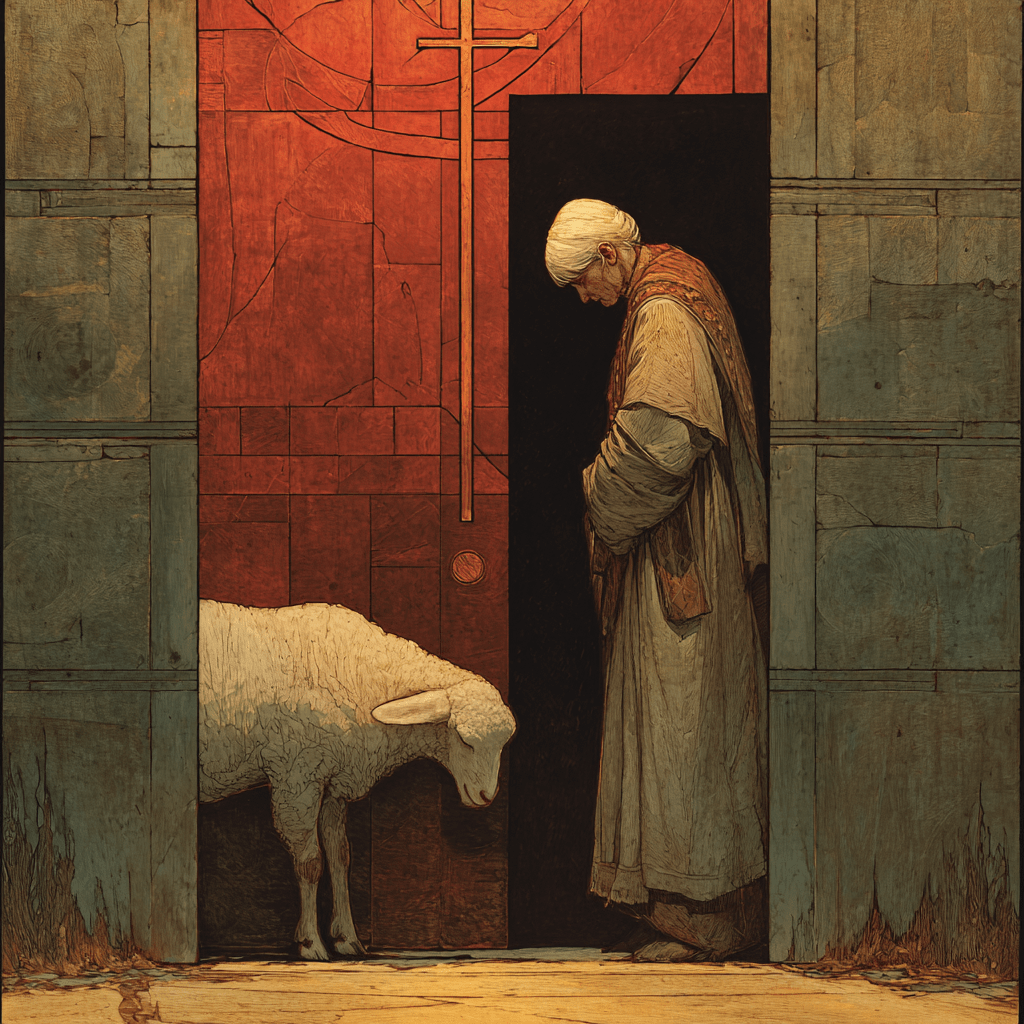
On Standing Empty-Handed Before the Slaughter — A Reflection for Week of the Publican and Pharisee (Fast-Free) on Exodus 12, Leviticus 25, and Isaiah 6
The Church opens her liturgical gates this week. No fast. No abstinence. Just the terrifying freedom of standing before God with nothing to offer but your need. This is the publican’s posture—empty hands, downcast eyes, a single prayer: *God, be merciful to me, a sinner.* The Pharisee brought his résumé; the publican brought his wound. One descended from the Temple justified. The other did not.
Now the Church sets before you the original Pascha—not yet Christ’s but its crimson shadow. *Take a lamb without blemish.* Kill it at twilight. Smear its blood on doorposts and lintel. Eat standing, loins girded, shoes on feet, staff in hand. Eat in haste. Death passes through Egypt tonight. Only blood marks the threshold between destruction and deliverance. You contribute nothing to this salvation except obedience and the willingness to slaughter what is innocent so that you, guilty, might live.
This is the scandal at the heart of Pascha. The lamb dies. You do not. And you must paint your house with its death.
Maximos the Confessor teaches that Christ “willingly endured the involuntary in our nature.” ([Ambiguum 7](https://example.com)) The Passover lamb reveals this ancient pattern: voluntary death absorbs involuntary mortality. The lamb’s innocent blood covers the threshold where the destroyer walks. Your threshold. Your house. Your firstborn sleeping upstairs while you stand in the dark with hyssop dripping red. You are learning what salvation costs—not your effort but another’s life poured out.
The publican knows this arithmetic. He brings no lamb, no offering, no coin for atonement. He stands at the back because he knows he has no right to approach. Yet his cry—*be merciful*—reaches further than the Pharisee’s inventory of virtues. Why? Because mercy flows toward emptiness, not fullness. Grace floods the space where pride has been evacuated. The Temple does not justify the righteous. It receives the ruined.
Now Isaiah enters the Holy of Holies and sees what the publican sensed from afar: the train of God’s robe filling the Temple, seraphim crying *Holy, holy, holy,* smoke and earthquake and the unbearable weight of Glory actually present. Isaiah’s response is not worship but terror: *Woe is me! I am undone!* Literally, *I am silenced, destroyed.* In the presence of actual holiness, self-righteousness disintegrates. Every word you have spoken reveals itself as unclean. Every thought you have harbored shows itself as ash.
But here is the mystery the Church places before you in this fast-free week: the seraph does not destroy Isaiah. He purifies him. *A live coal in his hand, taken with tongs from the altar.* The same fire that would consume brings cleansing. The coal touches Isaiah’s mouth—the very site of his proclaimed uncleanness—and the angel declares: *Your iniquity is taken away. Your sin is purged.*
Gregory of Nyssa writes that “the purification of the soul is the undoing of evil.” ([On Perfection](https://example.com)) Not punishment. Not penance performed to satisfaction. Undoing. The coal does not add something to Isaiah; it removes what was never truly his. Sin is the foreign element, the parasite, the distortion of what you are meant to be. Purification is the burning away of what obscures your face.
This is the inner work the publican accomplished and the Pharisee refused. To say *I am a sinner* is not self-hatred; it is precision. It names the misalignment between your choosing and your nature’s knowledge. Your natural will—what you are made for—remains oriented toward God, incorruptible, waiting beneath the rubble of your gnomic will’s poor choices. The publican descends into the gap between these two wills and cries out from that chasm. The cry itself begins the healing.
But notice: Isaiah’s purification is not the end. Immediately comes the call: *Whom shall I send? Who will go for Us?* And Isaiah, freshly undone and remade, responds: *Here am I; send me.* The coal that silences also empowers. The fire that destroys pride kindles mission. You cannot speak for God with unclean lips. But once those lips have been touched by altar-fire, you cannot remain silent.
The Exodus passage names this pattern in its fullness. The Passover is *a night to be much observed*—literally, a night of watching, of vigil. You eat standing because you are already in motion. The lamb’s death propels you toward freedom. Egypt’s bondage is ending. But the wilderness lies ahead, and the wilderness will reveal what Egypt concealed: your tendency to romanticize slavery when freedom demands too much.
Athanasius writes: “God became human that humans might become god.” ([On the Incarnation](https://example.com)) The Passover prefigures this exchange. The lamb’s life substitutes for yours, yes—but not so you remain unchanged. The blood on your threshold marks you as God’s possession. *Sanctify to Me all the firstborn.* You belong to the One who passed over your house. Your life is now His vigil, His watching, His patient transformation of mortality into glory.
This week the Church suspends the fast to teach you that asceticism is not the point. Humility is. The publican fasted twice a week—wait, no. That was the Pharisee. The publican brought only his need. And God met need with mercy, emptiness with fullness, death with life.
The coal is coming for your mouth. The blood is being painted on your threshold. The lamb is being slaughtered even now—has always been slaughtered, from the foundation of the world, in the eternal self-offering of the Lamb who stands as though slain before the throne. Your participation is not performance but reception. Not white-knuckling through Lent but letting the fast-free week hollow you out so that when the fast begins, it finds you already empty, already waiting, already standing at the back of the Temple with nothing to offer but the cry: *Be merciful.*
This is the threshold of Pascha. Blood and coal and the terrible freedom of standing before God with empty hands. The destroyer is passing through. The seraph is approaching with fire. The question is not whether you are worthy. You are not. The question is whether you will stand at the threshold and let the blood speak for you.
 The Greater Horizon