

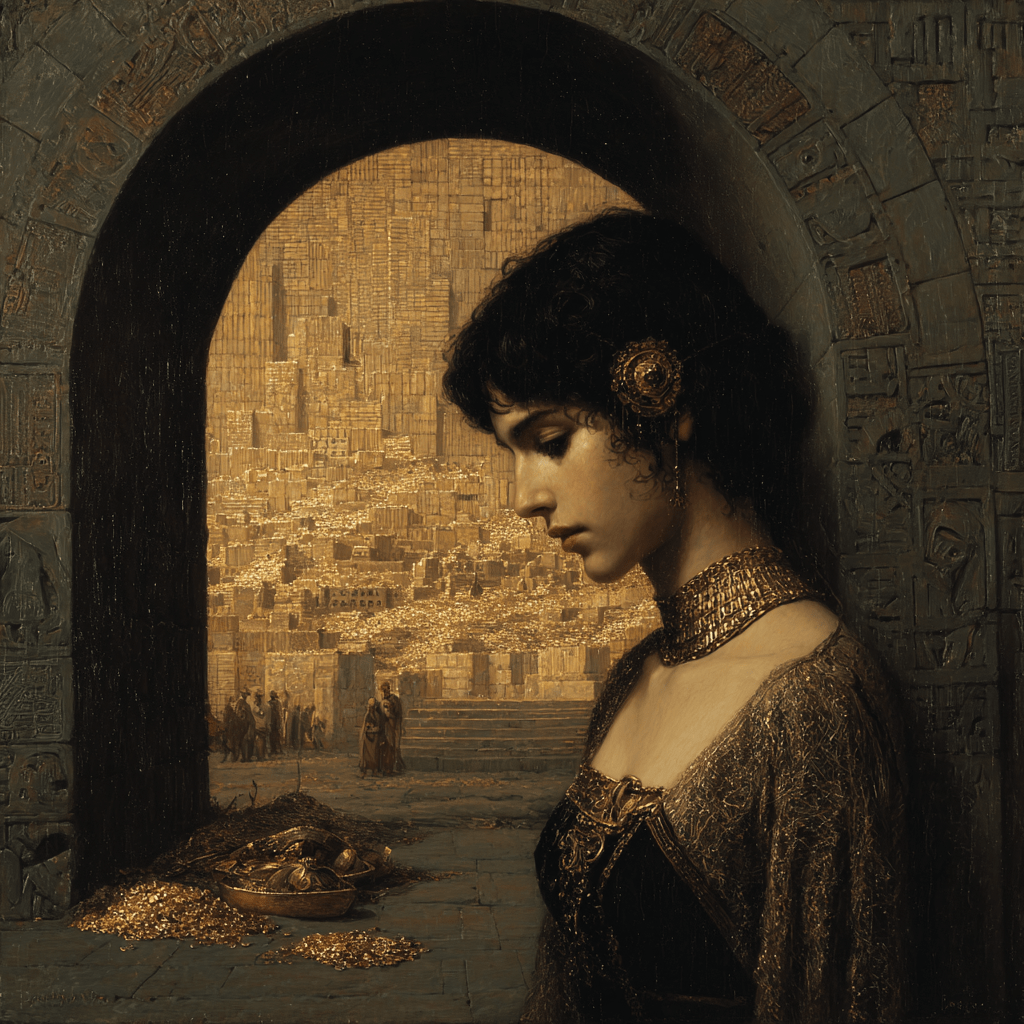
The Life of Saint Mary of Egypt (c. 344-421)
For seventeen years, Mary lived in Alexandria, the greatest city in the world. Ships from every nation crowded its harbors. Philosophers argued in its streets. The great Library held the wisdom of ages. And Mary knew every tavern, every theater, every dark corner where pleasure could be bought. She was beautiful, and she used that beauty like a weapon. She took money when it was offered, but often she refused it—corrupting others for the sheer joy of corruption was payment enough. She was like Circe from the Odyssey, turning men into swine, except she needed no magic. Just her presence was enough.
One summer, pilgrims crowded the docks, boarding ships bound for Jerusalem. A great festival was coming—the Exaltation of the Cross. Mary saw opportunity. Hundreds of men traveling together, far from home? She bought passage and turned the voyage into a floating bacchanal, leading travelers into revels that would have made Dionysus himself blush. The sailors asked for payment. She laughed and refused. Her presence was payment enough.
In Jerusalem, she followed the crowds toward the Church of the Holy Sepulchre. Everyone was pressing forward to venerate the True Cross. She pushed with them, curious, mocking internally. But at the threshold, something stopped her. Not someone—something. An invisible wall. She tried again. The crowd flowed past her like water around a stone. She could not enter. Four times she tried. Four times the doorway refused her.
Then, suddenly, she understood. The building would not let her in because she had spent seventeen years making herself into a lie. Every smile calculated. Every gesture performed. Every moment lived as manipulation. She had buried her true self so deep under layers of performance and predation that almost nothing remained. And the church—the place where God dwelt—could not receive her because she had made herself into something that could not receive God.
She wept. For the first time in years, real tears. Not performed grief, but actual sorrow. She saw herself as she truly was, and the sight was unbearable. She prayed to an icon of Mary the Theotokos: “Let me in, and I will change everything.”
The doors opened.
Inside, she venerated the Cross. Then she walked out of Jerusalem, across the Jordan River, and into the desert. For forty-seven years, she lived there alone. No shelter but caves. No food but whatever grew wild. Her clothes rotted away; her skin burned black under the merciless sun. For the first seventeen years, she fought herself—every memory a temptation, every habit clawing back toward life. But gradually, something shifted. The performed self died. The buried self emerged. Not the manipulator, not the predator—the woman she had been created to be before she buried herself in lies.
An old monk named Zosimas found her near the end. She walked above the ground when she prayed. She knew his thoughts before he spoke them. Not because she had become something other than human, but because she had finally become fully human—what humanity was always meant to be. The image of God, no longer buried under performance, shone through her like light through clean glass.
When she died, a lion came and helped Zosimas dig her grave. Even the desert had recognized what she had become: not a saint who escaped the world, but a woman who finally, after sixty-four years, became real.
Keywords: Mary of Egypt, Alexandria, desert transformation, shadow integration, repentance, theosis, Jerusalem,icon, fifth century, authenticity
 The Greater Horizon